
What Makes These Two Cancers Different?
Lymphoma is cancer that begins in lymphocytes — the white blood cells that are a key part of the immune system. Both Hodgkin lymphoma (HL) and non-Hodgkin lymphoma (NHL) originate in the lymphatic system, yet they are fundamentally distinct diseases with different biology, patterns of spread, and treatment approaches.
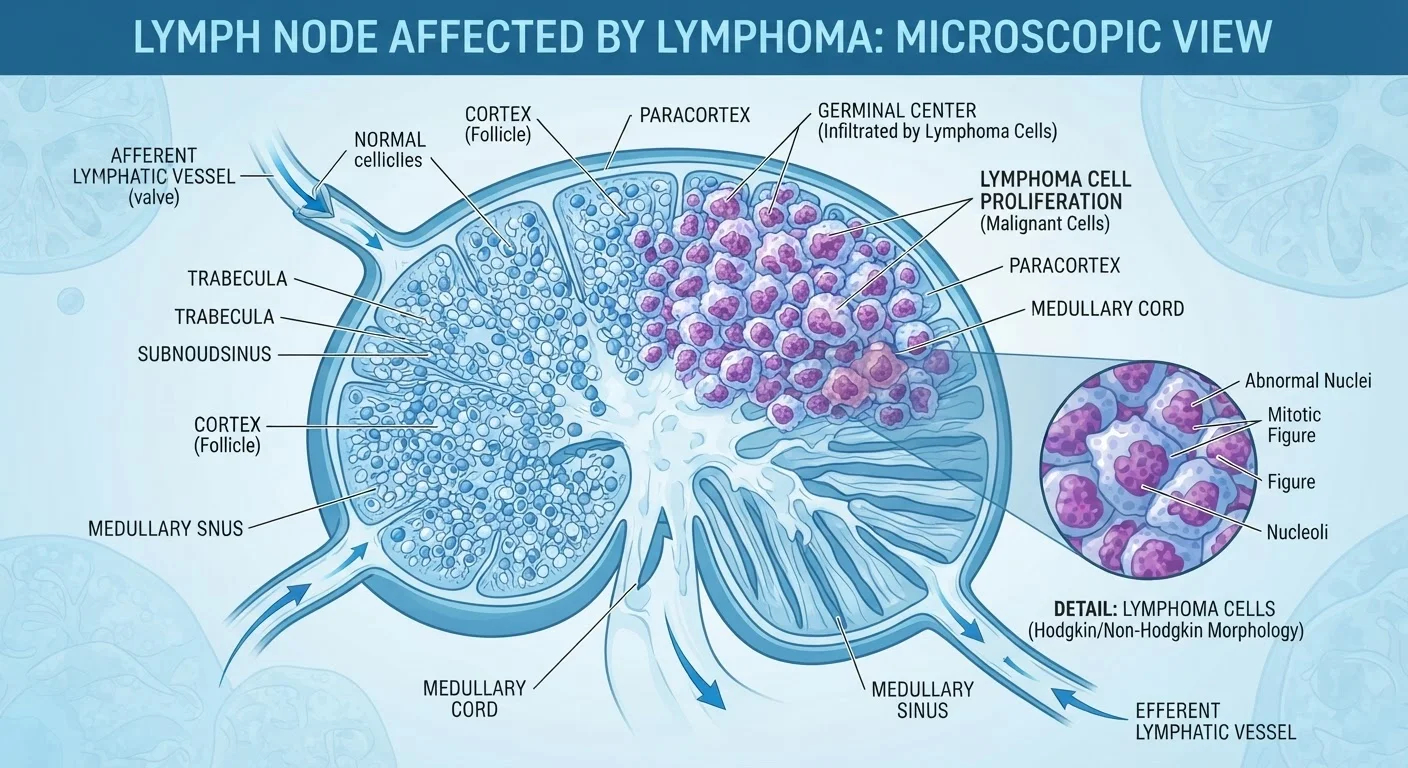
The defining difference lies in a specific cell type. Hodgkin lymphoma is characterized by the presence of Reed-Sternberg cells — large, abnormal cells visible under a microscope. When a biopsy does not reveal Reed-Sternberg cells, the diagnosis falls under the non-Hodgkin category. This single pathological distinction shapes everything from how the disease is staged to how it responds to therapy.
NHL is an umbrella term covering more than 60 distinct subtypes, arising from either B-cells or T-cells. Some subtypes are slow-growing (indolent), while others are aggressive and fast-spreading. HL, by contrast, is more biologically uniform, which partly explains its more predictable response to treatment. For a broader look at how cancer identification tools work, see how screening differs from diagnostic testing.
| Criterion | Non-Hodgkin Lymphoma | Hodgkin Lymphoma |
|---|---|---|
| Defining cell type | No Reed-Sternberg cells | Reed-Sternberg cells present |
| Annual US cases (approx.) | ~80,000 | ~8,500 |
| Cell of origin | B-cells or T-cells (60+ subtypes) | Primarily B-cells (more uniform) |
| Typical age at diagnosis | Most common after age 60 | Peaks at ages 20–34 and 55+ |
| Spread pattern | Unpredictable, often non-contiguous | Orderly, contiguous node-to-node |
| 5-year relative survival rate | ~73% (varies widely by subtype) | ~88% (overall) |
| Common treatment approaches | Chemotherapy, immunotherapy, radiation | Chemotherapy, radiation, targeted therapy |
Who Gets Each Type — and How Common Are They?
According to the American Cancer Society, non-Hodgkin lymphoma is one of the most common cancers in the United States, with approximately 80,000 new cases diagnosed each year. Hodgkin lymphoma, by contrast, accounts for roughly 8,500 new cases annually — making it considerably rarer.
~90%
Share of lymphomas that are non-Hodgkin
According to the American Cancer Society, the vast majority of lymphoma diagnoses in the US fall under the non-Hodgkin category.
~88%
5-year survival rate for Hodgkin lymphoma
The National Cancer Institute's SEER database reports an approximately 88% five-year relative survival rate for Hodgkin lymphoma overall.
60+
Recognized subtypes of non-Hodgkin lymphoma
The World Health Organization classifies over 60 distinct NHL subtypes based on cell type, genetic markers, and disease behavior.
Age is a notable differentiator. NHL is predominantly a disease of older adults, with incidence rising sharply after age 60. HL shows a bimodal age pattern, with one peak in young adults (ages 20–34) and a second in adults over 55. This means a 25-year-old with lymphoma and a 70-year-old with lymphoma may be facing very different diseases.
Both conditions occur in men and women, though NHL is slightly more common in men. Immune system suppression — whether from HIV, organ transplantation medications, or autoimmune conditions — is a recognized risk factor for NHL specifically. Just as different diseases affect different populations differently, understanding who is most at risk helps with earlier recognition, much as heart disease patterns differ between sexes.
Recognizing Symptoms and Getting a Diagnosis
The symptoms of both lymphoma types overlap considerably, which is why laboratory testing — not symptoms alone — determines the diagnosis. Common signs associated with both include:
- Painless swelling of lymph nodes in the neck, armpit, or groin
- Persistent fatigue not explained by other causes
- Unexplained weight loss
- Fever and night sweats (known as "B symptoms" in staging)
- Itching without a visible rash
Hodgkin lymphoma tends to spread in a more orderly, contiguous pattern — moving from one lymph node group to adjacent ones. NHL is more likely to spread unpredictably and may involve lymph nodes in multiple non-adjacent regions or spread to organs such as the liver, bone marrow, or gastrointestinal tract at earlier stages.
Diagnosis requires a biopsy — typically of an enlarged lymph node — followed by pathological examination to identify cell type and, critically, whether Reed-Sternberg cells are present. Imaging studies such as PET and CT scans help determine the extent of disease. No symptom checklist can replace a medical evaluation; anyone experiencing persistent, unexplained swollen lymph nodes should consult a healthcare provider promptly.
Why Biopsy Is the Only Definitive Answer
Swollen lymph nodes are common and can result from infections, inflammatory conditions, and many other causes unrelated to cancer. A biopsy is the only way to confirm a lymphoma diagnosis and determine its specific type. Pathological classification directly influences treatment planning, which is why the distinction between HL and NHL — and among NHL subtypes — matters clinically. Do not delay seeking medical evaluation if swelling persists beyond a few weeks without explanation.
This article is for general informational and educational purposes only and is not a substitute for professional medical advice, diagnosis, or treatment. Always consult a qualified healthcare provider with any questions about a medical condition.