
Why Inheritance Patterns Matter
When a genetic condition runs in a family, one of the first questions a genetic counselor asks is: how is it being passed down? The answer shapes everything from how likely family members are to be affected, to what screening steps might make sense. The two most common patterns for conditions carried on the non-sex chromosomes — called autosomes — are autosomal dominant and autosomal recessive inheritance.
Understanding the difference is not just academic. It helps older adults make sense of their own family history and have more informed conversations with their healthcare providers. As the Family Health History hub explains, knowing how a condition travels through a family is central to understanding your own health risks.
This article explains both patterns in plain language, without requiring a science background.
Autosomal Dominant: One Copy Is Enough
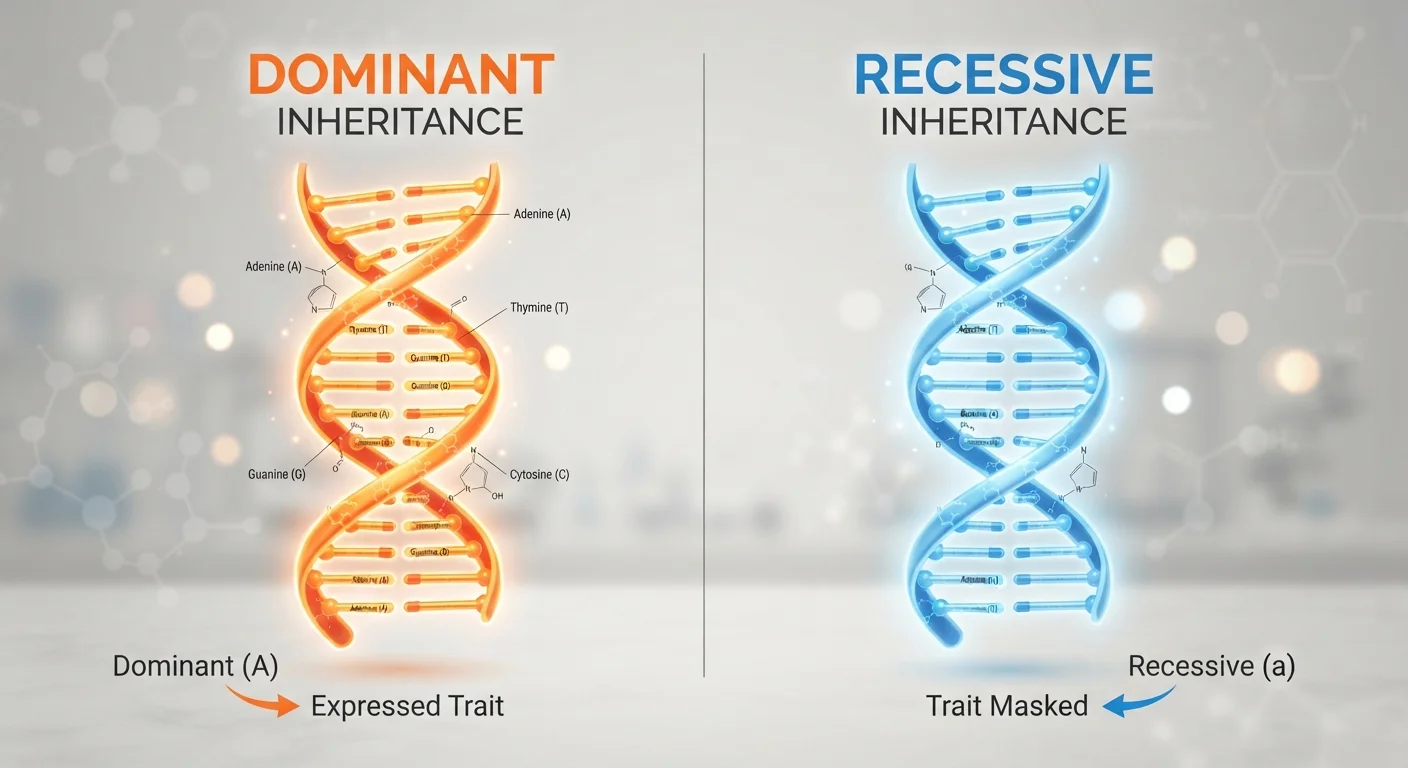
Every person carries two copies of most genes — one inherited from each parent. In autosomal dominant conditions, a single altered copy of a gene is sufficient to cause the condition. If one parent carries the altered copy, each child has roughly a 50% chance of inheriting it.
This is why dominant conditions tend to appear in every generation of an affected family. A grandparent, a parent, and a child may all show signs of the same condition. Common examples include familial hypercholesterolemia (abnormally high LDL cholesterol driven by genetics), Huntington's disease, and certain inherited forms of cancer risk linked to genes such as BRCA1 or BRCA2.
Importantly, not every person with the altered gene will experience the condition at the same severity or age of onset — a concept known as variable expressivity. Several dominant conditions only surface later in life, which is why family history records matter even for healthy older adults.
| Criterion | Autosomal Dominant | Autosomal Recessive |
|---|---|---|
| Copies needed to cause condition | One altered copy | Two altered copies |
| Carrier status | Carriers are typically affected | Carriers are usually unaffected |
| Generation pattern | Appears in every generation | Can skip generations |
| Risk to each child (one parent affected) | ~50% chance | ~25% chance (two carrier parents) |
| Examples | Huntington's, familial hypercholesterolemia | Cystic fibrosis, sickle cell disease |
| Family history visibility | Often clearly visible across generations | May be hidden until two carriers have children |
Autosomal Recessive: Two Copies Required
Recessive inheritance works differently. A person must inherit an altered gene copy from both parents to develop the condition. Someone who inherits only one altered copy is called a carrier — they typically have no symptoms but can pass the variant to their children.
This explains why recessive conditions can appear to skip generations. Two carrier parents — each healthy — face approximately a 25% chance with each pregnancy of having a child who inherits both altered copies and therefore has the condition. About 50% of their children will be carriers, and about 25% will inherit two typical copies. Well-known recessive conditions include cystic fibrosis, sickle cell disease, and phenylketonuria (PKU).
Carrier status is often unknown without genetic testing, since carriers have no outward signs. This is one reason why diagnosing genetic conditions requires different tools than a routine blood test or physical exam.
1 in 31
Americans are cystic fibrosis carriers
The Cystic Fibrosis Foundation estimates approximately 1 in 31 Americans carries one copy of the CFTR gene variant associated with cystic fibrosis, with no symptoms.
~50%
Risk per child with one dominant parent
When one parent carries an autosomal dominant variant, each child has approximately a 50% probability of inheriting that altered copy, according to standard Mendelian inheritance principles.
~7,000
Known rare genetic diseases
The National Institutes of Health estimates there are approximately 7,000 known rare diseases, a large proportion of which follow autosomal dominant or recessive inheritance patterns.
Key Differences at a Glance and What to Do Next
While the comparison table captures the structural differences, real families rarely match textbook patterns perfectly. Environmental factors, incomplete family records, and conditions with multiple inheritance routes can complicate the picture. It is also worth remembering — as explored in the article on genetic risk versus genetic destiny — that carrying a disease-linked variant is not the same as having a diagnosis or a guaranteed outcome.
If you are concerned about a pattern in your family history, speaking with a genetic counselor or your primary care physician is the most reliable first step. They can help interpret your family history, explain what testing might be appropriate, and put any results into context without overstating or understating risk. The plain-language reference guide to conditions that run in families is also a useful starting point for exploring specific diagnoses you may have encountered in your family.
This article is for general informational purposes only and does not constitute medical advice. Always consult a qualified healthcare professional for guidance specific to your health situation.