
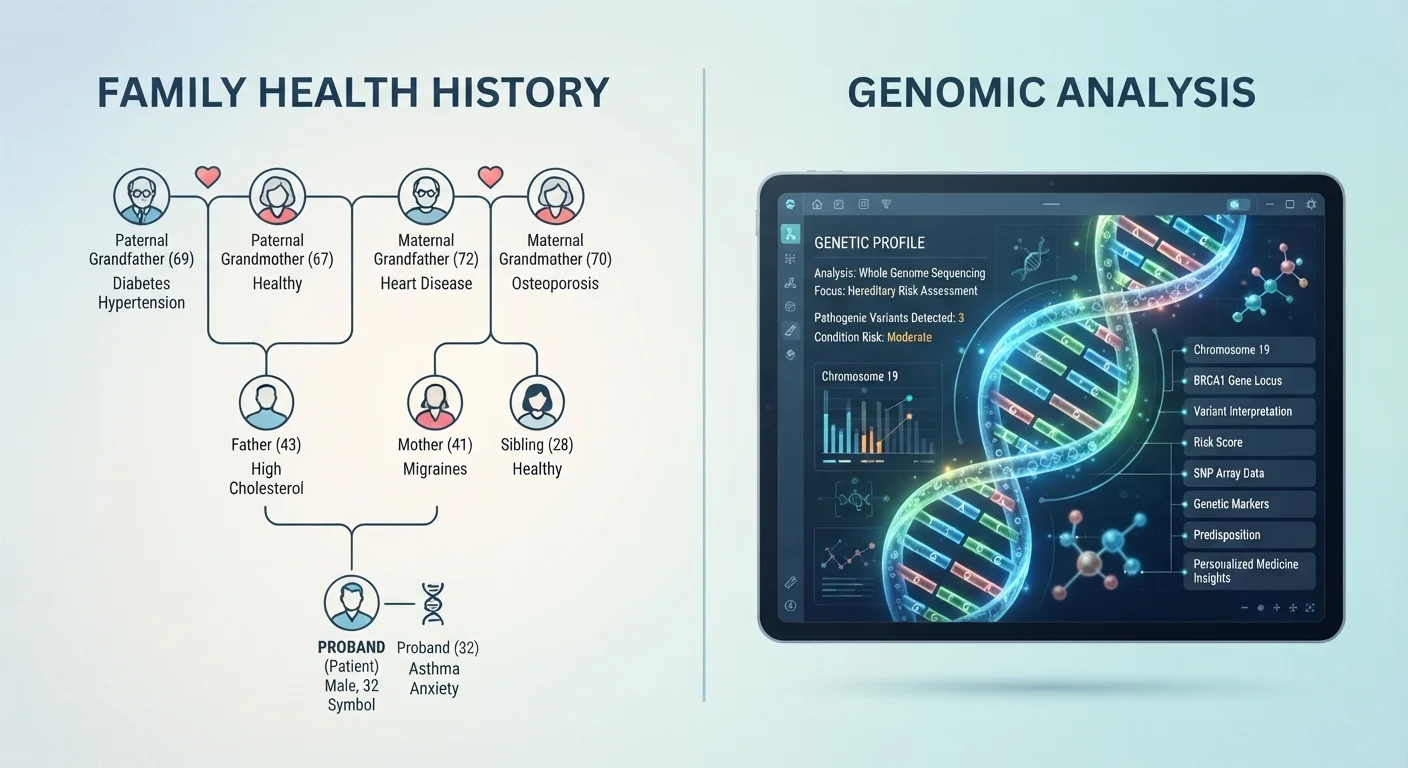
What Each Tool Actually Measures
Family health history and genetic testing are often mentioned in the same breath, but they measure fundamentally different things. Understanding that distinction helps you use both tools more effectively.
Family health history is a record of conditions — heart disease, diabetes, certain cancers, dementia — that have appeared across your biological relatives. It captures the combined influence of shared genes, shared environments, and shared behaviors. That breadth is both its strength and its limitation: it reflects real-world patterns without requiring any laboratory work, but it cannot pinpoint which specific gene, if any, is responsible. For a deeper look at why this information becomes increasingly valuable with age, see why family health history matters more as you age.
Genetic testing, by contrast, analyzes your DNA directly — looking for specific variants, mutations, or chromosomal changes associated with particular conditions. It can answer a precise question: do you carry a known variant in a gene linked to hereditary breast cancer, for example? What it cannot do is account for every gene involved in complex diseases, nor can it capture lifestyle or environmental influences. For a fuller picture of what these tests can and cannot detect, this balanced overview of genetic testing for disease risk is a useful companion read.
| Criterion | Family Health History | Genetic Testing |
|---|---|---|
| What it captures | Patterns across generations | Specific DNA variants |
| Cost and access | Free; no lab required | Varies; requires lab or clinic |
| Covers lifestyle/environment | Yes, implicitly | No |
| Precision of risk estimate | Broad probability | Specific variant presence or absence |
| Dependent on family knowledge | Yes — gaps are common | No — uses your DNA directly |
| Guides clinical referrals | Yes — standard first step | Yes — when history flags a concern |
| Result certainty | Indicative, not definitive | Precise but incomplete |
How Clinicians Use Them Together
In clinical practice, family history almost always comes first. Physicians use it as an initial screen — a way to identify patients who may need closer monitoring, earlier screening, or a referral to a genetic counselor. If a pattern emerges (say, multiple first-degree relatives diagnosed with colorectal cancer before age 50), that finding may trigger a recommendation for genetic testing to look for a hereditary cause such as Lynch syndrome.
This sequence matters because genetic testing is most informative when it is targeted. A test ordered without a clear clinical question can produce results that are difficult to interpret — variants of uncertain significance, for instance, that neither confirm nor rule out elevated risk. Understanding the difference between genetic risk and genetic destiny is essential context before acting on any result.
When a Genetic Counselor Can Help
If your family history raises concerns — or if a genetic test returns a complex result — a genetic counselor can help interpret what it means for your specific situation. Genetic counselors are trained to translate technical findings into practical guidance and to discuss options without pressure. Your primary care provider can typically refer you to one, or you can ask about counseling services through a hospital-based genetics department.
For older adults with a family pattern suggesting inherited cancer risk, what genetic risk means in cancer prevention offers practical framing for those conversations with your care team.
Limitations Worth Knowing
Neither tool is complete on its own. Family history depends on what relatives knew, shared, and accurately recalled — gaps are common, especially for conditions that carried stigma or went undiagnosed in earlier generations. Adoption, estrangement, or small family size can leave significant blanks.
Genetic testing has its own constraints. Most clinical tests look for variants in a defined set of genes; they do not scan your entire genome for every possible risk factor. A negative result means no known high-risk variant was found in the genes tested — it does not mean zero inherited risk. Complex conditions like type 2 diabetes or Alzheimer's disease involve dozens or hundreds of genetic contributors, environmental factors, and lifestyle variables that no single test can fully capture.
96%
Adults who have at least one common disease risk factor in their family history
Research published in the American Journal of Preventive Medicine found that the vast majority of adults have a family history suggesting elevated risk for at least one condition, yet many are unaware of it.
~5–10%
Cancers attributable to inherited gene mutations
According to the National Cancer Institute, only a fraction of cancers are directly caused by inherited single-gene mutations — the majority result from a combination of genetic, environmental, and lifestyle factors.
If you are considering direct-to-consumer DNA testing outside a clinical setting, it is worth understanding how those products differ from medically supervised genetic counseling — this comparison of genetic counselling and direct-to-consumer tests walks through the key distinctions. For questions about how genetic conditions are formally diagnosed, how genetic conditions are diagnosed differently from other illnesses provides helpful context.
This article is for general informational and educational purposes only and is not a substitute for personalized medical advice. Always consult a qualified healthcare professional before making decisions about genetic testing or health screening.