
Two Very Different Processes — Same Word
The word "arthritis" covers over 100 distinct conditions, but nearly all of them fall into one of two broad categories: inflammatory or non-inflammatory. Understanding which category applies to you is not a minor detail — it determines the likely cause of your pain, the tests your doctor may order, and the treatments that are most appropriate.
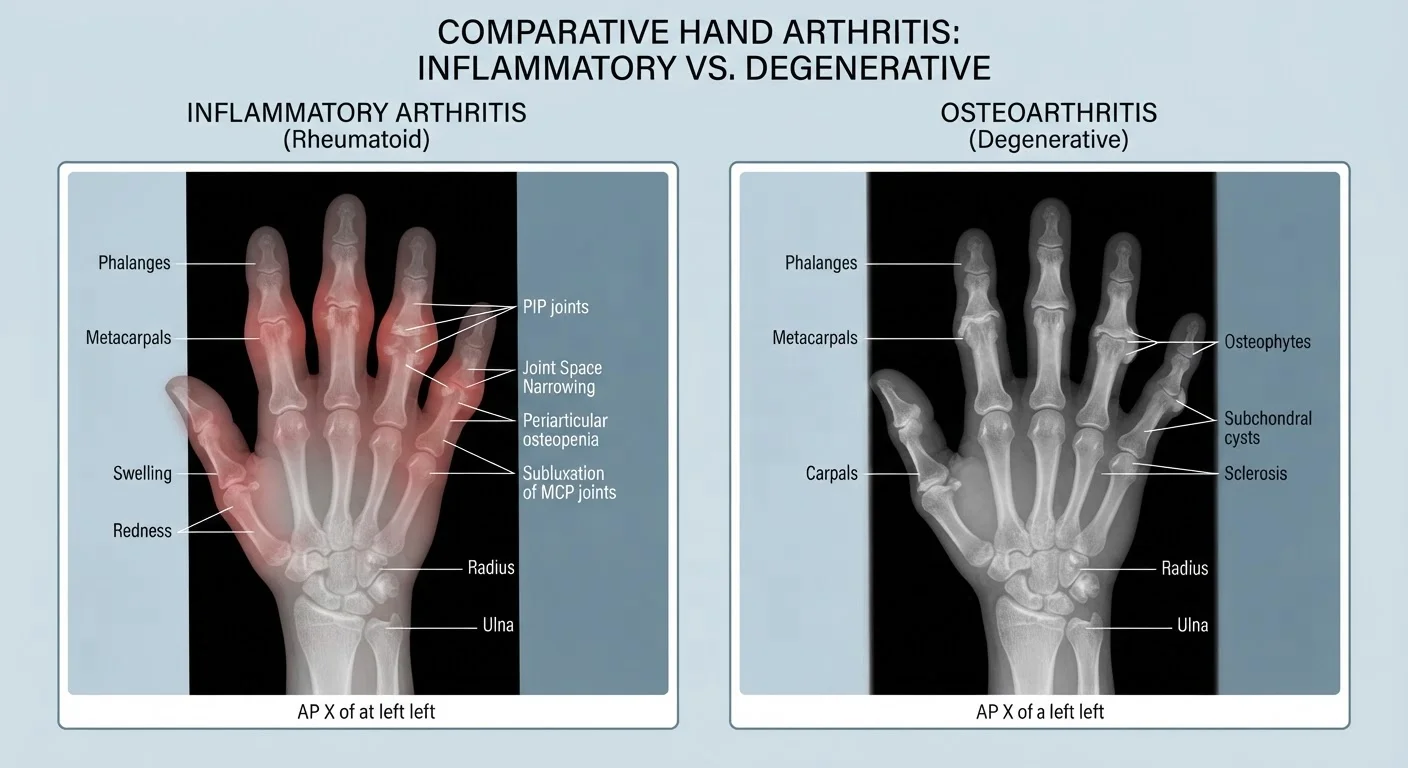
Non-inflammatory arthritis — most commonly osteoarthritis (OA) — develops when protective cartilage wears down over time due to age, repetitive use, or past injury. The joint deteriorates mechanically. Inflammation may occur as a secondary response, but the immune system is not the root driver.
Inflammatory arthritis — including rheumatoid arthritis (RA), psoriatic arthritis, gout, and lupus-related arthritis — involves the immune system mistakenly attacking joint tissue, producing persistent inflammation that damages cartilage, bone, and surrounding structures if left unmanaged. See our overview of rheumatoid arthritis as an autoimmune condition for a closer look at how immune involvement changes the picture.
How Symptoms Differ — And Why It Matters
Symptoms often overlap, which is why professional diagnosis is essential. That said, several patterns can help orient a conversation with your doctor.
| Criterion | Inflammatory Arthritis | Non-Inflammatory Arthritis |
|---|---|---|
| Primary cause | Immune system attacks joint tissue | Mechanical cartilage wear and tear |
| Morning stiffness | 45+ minutes, often longer | Usually under 30 minutes |
| Joint pattern | Often symmetric, multiple joints | Often one joint, weight-bearing areas |
| Systemic symptoms | Fatigue, fever, or weight loss possible | Typically localised to joint area |
| Blood inflammation markers | CRP and ESR often elevated | Typically normal or mildly elevated |
| Common examples | RA, gout, psoriatic arthritis, lupus | Osteoarthritis |
| Pain pattern | Often worse at rest, eases with movement | Worsens with activity, improves with rest |
Morning stiffness is one of the most telling signals. In osteoarthritis, stiffness typically resolves within 30 minutes of gentle movement. In inflammatory arthritis, stiffness commonly persists for 45 minutes or longer — sometimes several hours — because the immune-driven swelling takes time to subside.
Inflammatory arthritis also tends to affect joints symmetrically (both wrists, both knees) and may cause systemic symptoms such as fatigue, low-grade fever, or weight loss — signs that the immune system is broadly activated. Non-inflammatory arthritis is more likely to affect one joint at a time, particularly weight-bearing joints like the hip or knee.
32.5M
US adults affected by osteoarthritis
The CDC estimates over 32 million US adults live with osteoarthritis, making it the most common form of non-inflammatory arthritis.
~1.5M
US adults with rheumatoid arthritis
The Arthritis Foundation estimates approximately 1.5 million Americans have rheumatoid arthritis, the most prevalent form of inflammatory arthritis.
45+ min
Morning stiffness threshold for inflammatory arthritis
Rheumatology clinical guidelines use prolonged morning stiffness lasting 45 minutes or more as a key diagnostic indicator for inflammatory joint disease.
For a broader look at how these and other arthritis types are defined and categorised, the arthritis types reference guide provides a useful overview.
Diagnosis: What Clinicians Look For
Distinguishing between the two categories involves a combination of clinical evaluation, imaging, and laboratory tests. Blood tests such as C-reactive protein (CRP) and erythrocyte sedimentation rate (ESR) measure levels of systemic inflammation. Elevated values point toward an inflammatory process. Additional markers — including rheumatoid factor (RF) and anti-CCP antibodies — help identify specific inflammatory conditions.
Imaging such as X-ray or MRI can reveal cartilage loss, bone erosion, or joint-space narrowing, providing structural evidence that complements blood results. It is worth noting that imaging and blood tests must be interpreted together with symptoms; no single test is definitive on its own.
Conditions Can Overlap
It is possible to have both inflammatory and non-inflammatory arthritis simultaneously. For example, a person with osteoarthritis may later develop an inflammatory condition such as rheumatoid arthritis. Overlapping conditions can mask each other's symptoms, which is why a thorough clinical evaluation — including blood tests, imaging, and physical examination — is important rather than assuming a single diagnosis explains all symptoms.
Both types can coexist. An older adult with long-standing osteoarthritis may also develop rheumatoid arthritis, making diagnosis more complex. This is another reason why personalised clinical assessment — rather than self-diagnosis — is the appropriate path.
Why the Classification Shapes Treatment
Treatment goals differ substantially between the two categories. For non-inflammatory arthritis, management typically focuses on protecting remaining joint structure, managing pain, and maintaining function through physical activity, weight management, and in some cases assistive devices or surgery.
For inflammatory arthritis, the priority is controlling immune-driven inflammation to prevent joint damage from progressing. Disease-modifying medications, which work on the immune system rather than simply masking pain, are a cornerstone of inflammatory arthritis care. These require specialist oversight and monitoring.
Diet is a topic that comes up often — and for good reason, particularly in inflammatory arthritis. However, evidence varies by condition and individual. The evidence on diet and joint pain is worth reviewing with realistic expectations.
If you have joint symptoms that concern you, a detailed discussion with a qualified healthcare professional is the essential next step. For context on how lupus-related joint disease differs from other inflammatory types, see lupus-related arthritis and its distinct features. A comparison of osteoarthritis and rheumatoid arthritis specifically is covered in detail in osteoarthritis vs. rheumatoid arthritis.
This article is for general informational purposes only and does not constitute medical advice. Always consult a qualified healthcare professional regarding any joint symptoms, diagnosis, or treatment decisions.