
What Osteoarthritis Actually Is
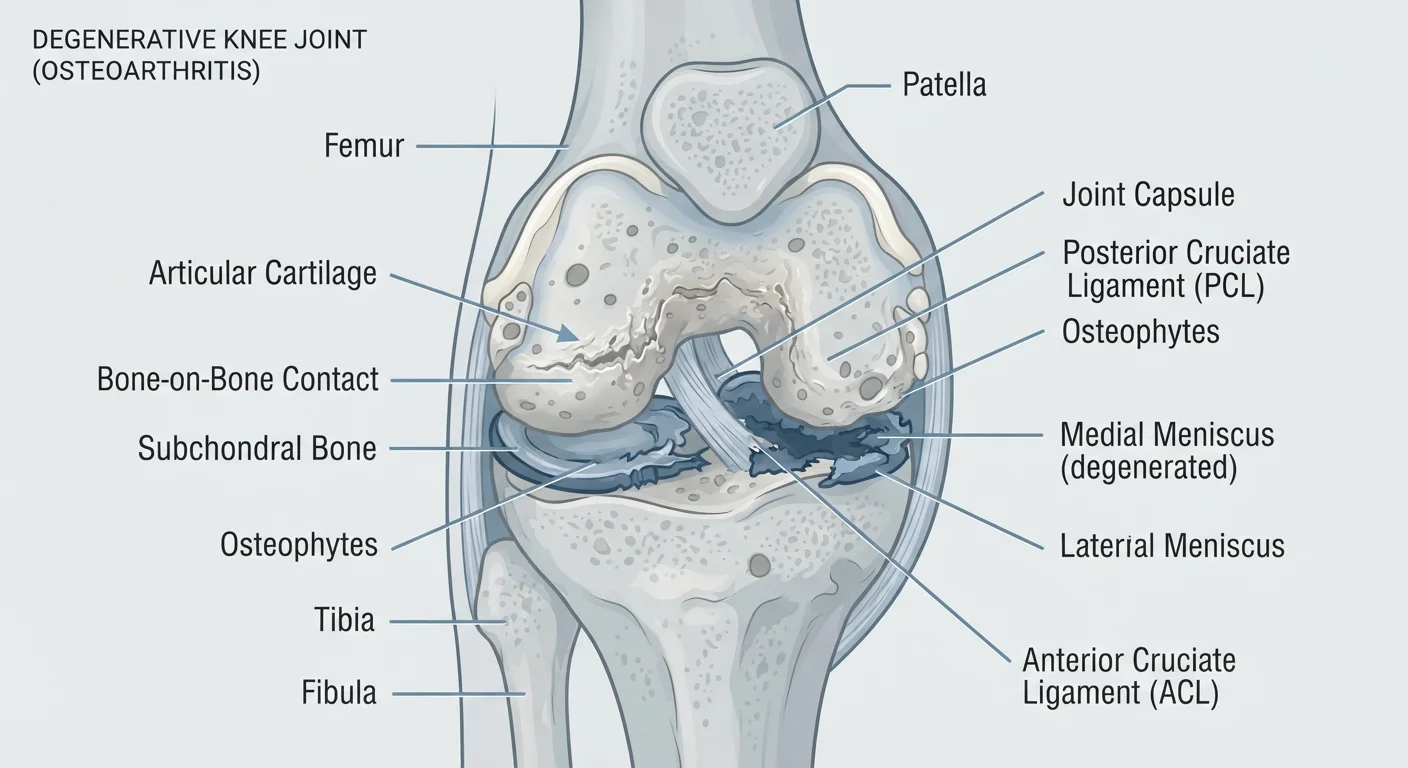
Osteoarthritis is often described simply as "wear and tear," but that phrase undersells what is actually happening inside the joint. OA is a complex disease process that changes the structure of the entire joint — not just the cartilage on the surface.
Healthy cartilage is a firm, slippery tissue that covers the ends of bones where they meet. Its job is to absorb shock and allow smooth, nearly friction-free movement. In a joint affected by OA, this cartilage gradually thins, softens, and develops irregular surface cracks. Because cartilage contains no blood vessels, it has very limited capacity to heal itself. Once it is lost, it does not readily grow back.
As cartilage breaks down, the body attempts to compensate. The bone beneath begins to thicken and may develop small bony outgrowths called osteophytes (commonly called bone spurs). The synovial membrane — the thin tissue lining the joint capsule — can become irritated and produce excess fluid, causing swelling. Over time, ligaments and muscles around the joint also weaken, reducing overall stability. For a broader look at how joint deterioration unfolds with age, see what's happening inside aging joints.
OA Versus Normal Aging: An Important Distinction
Some degree of joint change is expected as we age — cartilage naturally loses some water content and elasticity over decades. However, osteoarthritis represents a pathological acceleration of that process, driven by a combination of mechanical stress, genetic susceptibility, and biological factors. Not every older adult develops symptomatic OA, and not everyone with OA on imaging experiences significant pain. The relationship between structural changes and symptoms is complex and varies considerably between individuals.
Which Joints Are Most Vulnerable — and Why
OA does not affect all joints equally. The joints that bear the most mechanical load over a lifetime are the most susceptible:
- Knees — The most commonly affected joint in OA. The knee absorbs forces several times body weight with every step, making it highly vulnerable to cumulative stress.
- Hips — Hip OA causes groin or outer thigh pain and can significantly restrict walking and stair climbing.
- Hands — OA in the fingers and at the base of the thumb is especially common in women and often has a strong hereditary component.
- Spine — Facet joints in the cervical (neck) and lumbar (lower back) regions frequently develop OA, contributing to back stiffness and sometimes nerve compression.
Joints that have previously been injured — through sports trauma, workplace accidents, or repetitive strain — are also significantly more likely to develop OA earlier. Understanding how daily routines affect joint load is equally important; our article on habits that quietly wear down joints explains which common activities place unnecessary stress on joint structures.
32.5 million
U.S. adults estimated to have osteoarthritis
According to the Centers for Disease Control and Prevention (CDC), OA is the most common form of arthritis in the United States.
~4×
Extra knee force per pound of body weight
Research published in the journal Arthritis & Rheumatism found that each pound of body weight exerts roughly four pounds of force on the knee joint during walking.
50%+
Of adults over 65 show OA changes on imaging
Studies consistently find that more than half of adults aged 65 and older have radiographic (X-ray) evidence of OA in at least one joint, though not all experience symptoms.
Recognising the Symptoms of Osteoarthritis
OA symptoms tend to develop slowly and worsen over months to years. The most common signs include:
- Joint pain that increases with activity and eases with rest, particularly in the earlier stages
- Morning stiffness that typically resolves within 30 minutes — a key feature that helps distinguish OA from inflammatory arthritis types such as rheumatoid arthritis, where morning stiffness often lasts much longer
- A grating or crackling sensation (called crepitus) when moving the joint
- Swelling around the joint, caused by excess synovial fluid or bony enlargements
- Reduced range of motion, making everyday tasks like bending, gripping, or climbing stairs progressively harder
Symptoms often fluctuate — many people report "good days" and "bad days" without a clear trigger. Weather changes and activity levels can influence how much discomfort a person experiences on a given day. For an overview of how OA compares to other arthritis conditions, the plain-language guide to arthritis types is a useful starting point.
Track Your Symptoms Before Your Appointment
Before seeing a healthcare provider about joint pain, consider keeping a simple journal for two to three weeks. Note which activities aggravate pain, how long morning stiffness lasts, and whether swelling is present. This information helps clinicians distinguish OA from other joint conditions and guides more effective next steps.
Risk Factors and What Influences Progression
Several well-established factors increase the likelihood of developing OA or accelerate how quickly it progresses:
- Age
- The risk of OA rises steadily from middle age onward, though OA is not an automatic consequence of getting older.
- Body weight
- Excess body weight places additional load on weight-bearing joints. Research consistently shows that even modest weight reduction can meaningfully reduce knee pain and slow structural progression in people with OA.
- Sex
- Women are more likely than men to develop OA — particularly hand and knee OA — and tend to experience more severe symptoms. Hormonal factors are thought to contribute, though the precise mechanisms are still being studied.
- Previous joint injury
- A torn meniscus, ligament damage, or fracture near a joint substantially raises future OA risk in that joint.
- Genetics
- A family history of OA — especially hand OA — increases personal risk, indicating a hereditary component.
- Occupation and repetitive movements
- Jobs or activities involving repeated kneeling, squatting, or heavy lifting are associated with higher rates of knee and hip OA.
While some risk factors cannot be changed, others — particularly weight management and joint-protective movement habits — offer meaningful opportunities for individuals to influence their trajectory. Exploring joint health habits that support long-term joint resilience is a practical next step for anyone concerned about OA risk.
This article is for general informational purposes only and does not constitute medical advice. If you are experiencing persistent joint pain or suspect you may have osteoarthritis, please consult a qualified healthcare professional for a proper evaluation and personalised guidance.