
Why These Three Types Are Not the Same
Skin cancer is the most commonly diagnosed cancer in the United States, according to the American Cancer Society, yet the label covers meaningfully different diseases. Basal cell carcinoma (BCC), squamous cell carcinoma (SCC), and melanoma each originate in a different layer or cell type of the skin, grow at different rates, and carry very different risks of spreading.
For older adults who have accumulated decades of sun exposure, understanding these distinctions can be the difference between catching a problem early and facing a more serious diagnosis. Cumulative UV exposure over a lifetime is a primary driver of all three, but risk profiles diverge from there.
| Basal Cell Carcinoma | Squamous Cell Carcinoma | Melanoma | |
|---|---|---|---|
| Cell of origin | Basal cells (deep epidermis) | Squamous cells (outer skin layer) | Melanocytes (pigment cells) |
| Relative frequency | Most common (~80% of cases) | Second most common | Least common of the three |
| Typical appearance | Pearly bump or flat waxy lesion | Firm red nodule or crusted plaque | Asymmetric mole with color variation |
| Risk of spreading | Very low | Low to moderate (2–5%) | High if not caught early |
| Primary risk factor | Cumulative UV exposure | UV exposure, HPV, immunosuppression | UV exposure, family history, many moles |
| Typical locations | Face, ears, neck | Scalp, hands, lips, ears | Back, legs, neck, face |
| Overall prognosis (early detection) | Excellent | Very good | Good to excellent (stage-dependent) |
Basal Cell Carcinoma: Most Common, Slowest Growing
Basal cell carcinoma arises in the basal cells — the deepest layer of the epidermis (outer skin). It accounts for roughly 80% of all skin cancers diagnosed in the U.S. BCC grows slowly and almost never spreads to distant organs, but untreated tumors can invade nearby tissue, nerves, and bone over time.
How it looks: BCC most often appears as a pearly or waxy bump, a flat flesh-colored lesion, or a sore that heals and then reopens. Sun-exposed areas — the face, ears, and neck — are the most frequent sites.
Who is most at risk: Fair-skinned individuals with a long history of sun exposure, those who have had prior radiation therapy to the skin, and people with weakened immune systems face elevated risk. The National Cancer Institute notes that BCC is rare in people under 40 but increases steadily with age.
Conduct a Monthly Skin Self-Examination
Use a full-length mirror and a hand mirror to examine your entire body, including the scalp, between toes, and beneath nails. Look for any new growth, sore that won't heal, or a spot that looks different from others — dermatologists call this an 'ugly duckling' lesion. Document changes with dated photos. Report anything new or evolving to your healthcare provider promptly rather than waiting for a scheduled visit.
Squamous Cell Carcinoma: More Aggressive Than BCC
Squamous cell carcinoma develops in the squamous cells that make up most of the skin's outer surface. It is the second most common skin cancer, and while it is also strongly tied to UV exposure, it carries a higher risk of spreading than BCC — roughly 2–5% of cases metastasize to regional lymph nodes if left untreated.
How it looks: SCC typically presents as a firm red nodule, a flat lesion with a scaly, crusted surface, or a new sore within an old scar. It can also develop on the lips or inside the mouth, on the genitals, or in scars and chronic wounds — sites not always associated with sun exposure.
UV exposure contributes to SCC through direct DNA damage in skin cells, but additional risk factors include human papillomavirus (HPV) infection, immunosuppression, and long-term exposure to certain chemicals. Older adults and organ transplant recipients are at notably elevated risk.
Melanoma: Rarest Among the Three, Highest Risk
Melanoma originates in melanocytes — the pigment-producing cells found in the deepest layer of the epidermis. It represents a minority of skin cancer cases but accounts for the large majority of skin cancer deaths, according to the American Cancer Society, because of its strong tendency to spread to lymph nodes and distant organs.
How it looks: The ABCDE rule is the widely accepted screening guide: Asymmetry, Border irregularity, Color variation, Diameter greater than 6 mm (about the size of a pencil eraser), and Evolving size, shape, or color. Not all melanomas follow every criterion, so any changing mole deserves prompt evaluation.
Family history plays a meaningful role: certain inherited gene variants can significantly elevate lifetime risk. Understanding how inherited gene variants affect cancer risk can help guide decisions about more frequent dermatology screening.
~100,000
New melanoma cases diagnosed annually in the U.S.
According to the American Cancer Society's estimates, approximately 100,000 new melanoma diagnoses occur each year in the United States.
~8,000
Annual U.S. deaths attributed to melanoma
The American Cancer Society estimates roughly 8,000 Americans die from melanoma each year, underscoring the importance of early detection.
99%
Five-year survival rate for localized melanoma
When melanoma is detected before it spreads beyond the skin, the five-year relative survival rate approaches 99%, according to National Cancer Institute SEER data.
Detection, Diagnosis, and When to Seek Care
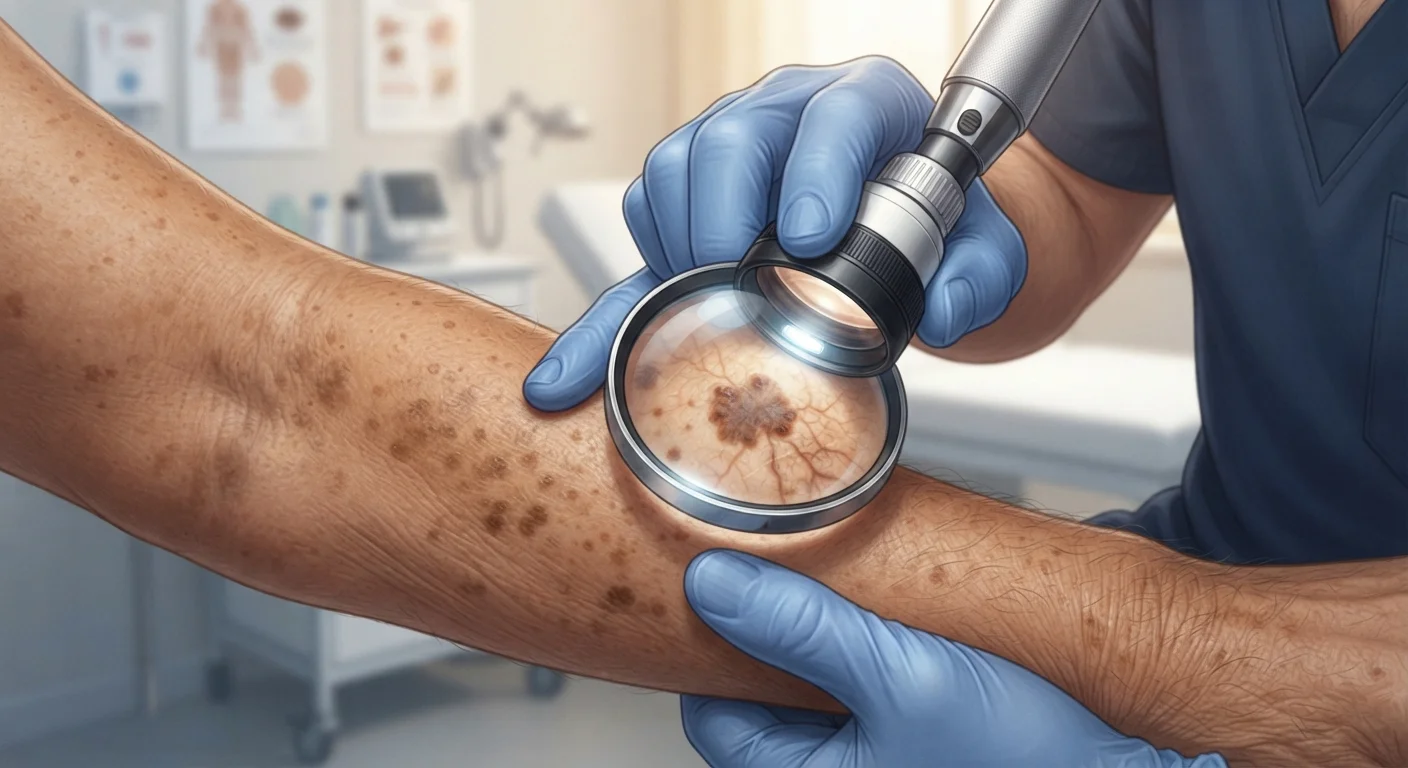
All three cancers are diagnosed through biopsy — a small tissue sample examined under a microscope. Self-examination is a valuable complement to professional screening: a monthly head-to-toe skin check in good lighting can surface new or changing lesions early.
The American Academy of Dermatology recommends annual full-body skin examinations by a dermatologist, particularly for adults over 50 with a history of significant sun exposure, multiple moles, or a personal or family history of skin cancer. Suspicious spots should never be monitored at home alone while waiting to see if they change — prompt professional evaluation is the appropriate step.
This article is for general informational purposes only and does not constitute medical advice. Always consult a qualified healthcare provider about any skin changes, symptoms, or concerns specific to your health.