
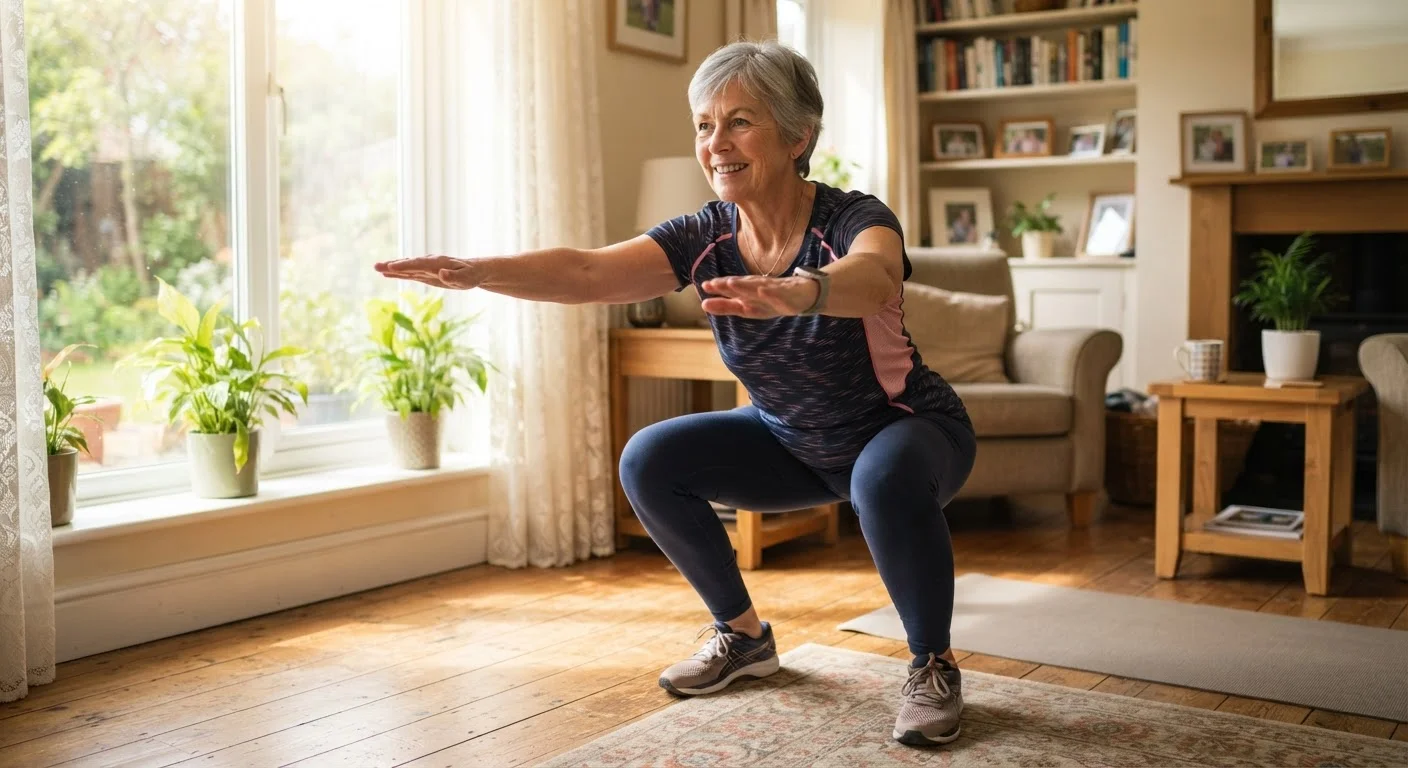
What Makes Exercise 'Functional'?
The word functional has become common in fitness conversations, but it has a specific and useful meaning. An exercise is functional when it trains a movement pattern your body uses in real life. Pushing open a heavy door, lowering yourself onto a chair, picking something up off the floor — these all involve coordinated strength, balance, and range of motion working together.
Contrast that with a seated leg extension machine, which isolates the quadriceps but does not require the stabilizing muscles, balance adjustments, or coordination involved in actually standing up from a low seat. Both exercises build strength, but only one directly rehearses the movement you depend on every day.
Functional fitness organizes training around six foundational movement patterns: squat, hinge, push, pull, carry, and rotate. Each maps to common daily activities. Squatting covers sitting and rising; hinging covers lifting from the floor; pushing covers getting up from the ground or pushing objects away; pulling covers opening doors or pulling yourself up; carrying covers shopping bags or grandchildren; rotating covers looking behind you while driving or reaching across your body.
For a plain-language breakdown of fitness terms used in this area, see the Key Terms in Senior Fitness reference guide.
Why It Matters More as You Age
As the body ages, muscle mass, bone density, and neural coordination all gradually decline — a process called sarcopenia for the muscle component. These changes can make formerly automatic movements — stepping off a curb, carrying laundry up stairs — feel effortful or even risky. Functional fitness directly addresses these specific vulnerabilities.
1 in 4
Older adults who fall each year
According to the U.S. Centers for Disease Control and Prevention (CDC), approximately one in four adults aged 65 and older reports a fall each year.
~3%
Annual muscle mass loss after age 60
Research published in clinical aging literature estimates that adults can lose roughly 3–5% of muscle mass per decade after 30, with losses accelerating after age 60 without resistance training.
34%
Fall risk reduction with exercise programs
A Cochrane review of exercise interventions found that balance and strength training programs reduced fall rates in older adults by approximately 34% compared to control groups.
Balance training, a cornerstone of functional fitness, is particularly important. Falls are one of the leading causes of injury-related hospitalization among adults 65 and older, and research consistently shows that exercise programs targeting balance and lower-body strength can meaningfully reduce fall risk. Single-leg stands, tandem walking, and lateral step exercises are simple examples that train the neuromuscular responses needed to catch a stumble before it becomes a fall.
Functional fitness also supports what researchers call functional independence — the ability to live on your own terms without requiring assistance for basic daily tasks. This is not merely a quality-of-life concern; it has well-documented connections to mental health, cognitive engagement, and longevity. For a broader look at how movement preserves independence, see Movement Habits That Support Independence in Later Life.
Start With What You Already Do
You do not need a gym to begin functional fitness. Start by paying attention to which daily movements feel difficult — getting off the floor, carrying bags, stepping over a threshold. Those are your training targets. Practice them deliberately, with control and attention to form, and you are already doing functional fitness. A physical therapist or certified fitness professional with senior fitness experience can help you progress safely.
How Functional Fitness Fits Into a Complete Routine
Functional fitness is not a replacement for aerobic exercise or flexibility work — it is a complement. A well-rounded routine for older adults typically includes cardiovascular activity (walking, swimming, cycling), strength training, flexibility and mobility work, and balance training. Functional exercises often overlap several of these categories at once, which is part of their efficiency.
Understanding how aerobic and resistance training each contribute is worth exploring separately. The Aerobic vs. Resistance Exercise explainer covers what each type uniquely offers aging bodies. Similarly, joint mobility — closely related to functional movement capacity — is addressed in the Role of Flexibility and Mobility in Aging Well.
For a comprehensive overview of all components together, the Active Aging full guide brings them into a single framework tailored to adults over 60.
“The purpose of exercise for older adults should not be to look like an athlete — it should be to function like a capable, independent person. Train the movements life demands of you.”
— Miriam Nelson, Exercise researcher and author focused on strength training and aging
This article is for general informational purposes only and does not constitute medical advice. Always consult a qualified healthcare professional before beginning a new exercise program, particularly if you have existing health conditions, chronic pain, or recent injury.