
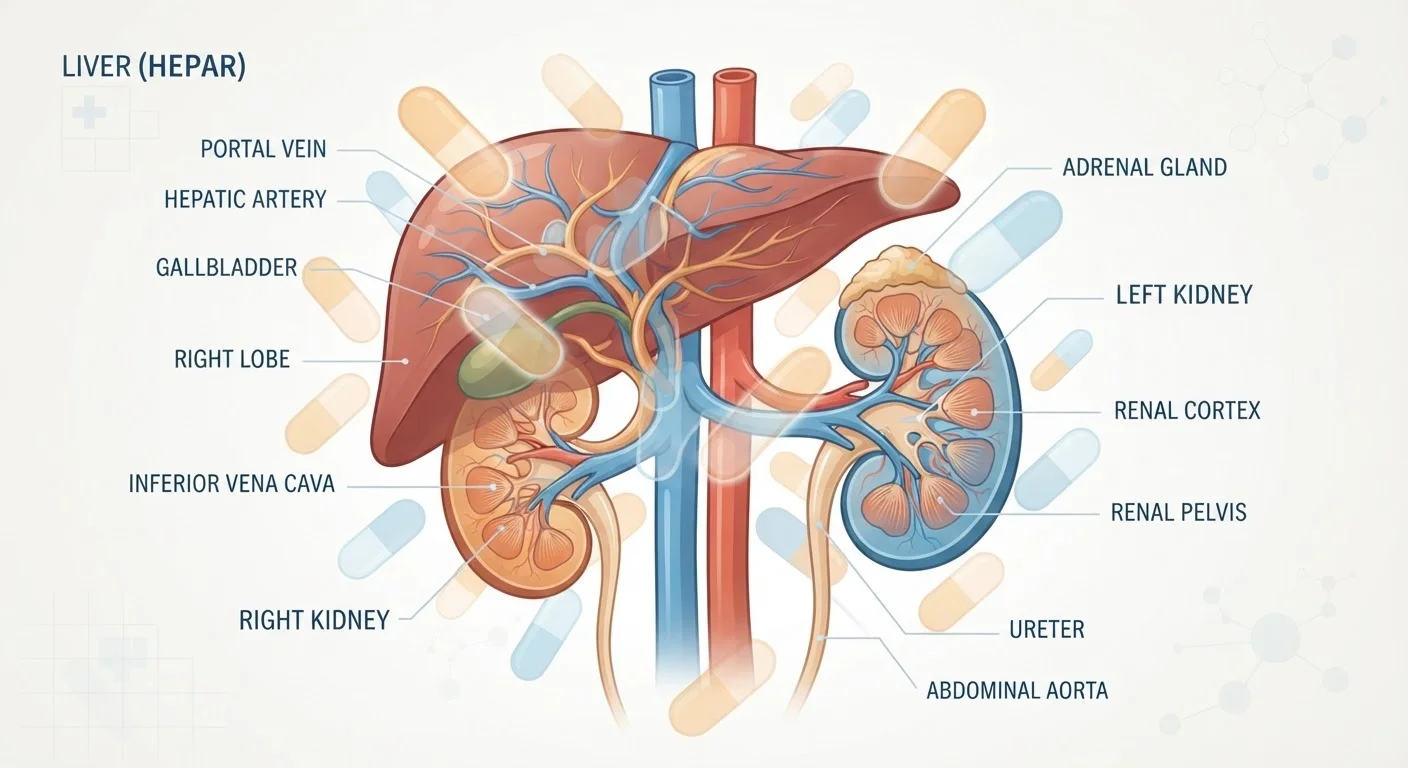
The Body's Two-Stage Drug Removal System
When you swallow a pill, your body immediately begins working to eliminate it. This happens in two broad stages: metabolism and excretion.
Metabolism — mainly handled by the liver — transforms the drug chemically into compounds that are easier to remove. Excretion — mainly handled by the kidneys — filters those compounds out of your blood and sends them out of the body through urine. Think of the liver as a processing plant and the kidneys as a filtration system. Both must function well for medications to leave your body on schedule.
This matters for one practical reason: if either organ slows down, drugs stay in your system longer than intended. That can quietly push levels higher than your prescriber planned for — sometimes causing side effects that feel confusing or seem unrelated to your medication.
Not All Drugs Use the Same Pathway
While the liver-to-kidney route is the most common, some medications bypass this path entirely. A small number of drugs are excreted unchanged through the kidneys without any liver processing, while others leave the body through bile, exhaled air, or sweat. Your pharmacist can tell you which elimination pathway applies to your specific medications.
What the Liver Actually Does to a Medication
The liver is home to a large family of enzymes — proteins that speed up chemical reactions — known as the cytochrome P450 system (often abbreviated CYP450). These enzymes break most drugs into smaller, water-soluble metabolites, which are easier for the kidneys to filter.
Some medications arrive in the body as inactive forms, called prodrugs, and rely on the liver to convert them into their active, working form. Others are already active and the liver simply deactivates and prepares them for removal.
Certain foods and supplements can interfere with these liver enzymes — for example, grapefruit is well-known for blocking enzymes that process several common medications. Learn how food and supplements can alter a drug's effect for a closer look at that topic.
~90%
Medications processed by the liver
Pharmacological research consistently estimates that the large majority of approved drugs undergo at least some hepatic (liver) metabolism before elimination.
~50%
Decline in kidney filtration rate by age 75
Studies in renal physiology indicate that kidney filtration capacity can fall by roughly half between young adulthood and age 75 in otherwise healthy individuals.
2x+
Higher adverse drug event rates in older adults
Research published in clinical pharmacology literature consistently finds that adults over 65 experience adverse drug events at substantially higher rates than younger populations, partly due to organ function changes.
How Aging Changes Kidney and Liver Function
Here is where the picture becomes especially relevant for older adults. Both the liver and kidneys undergo measurable changes as part of normal aging — independent of any disease.
- Liver: Liver mass and blood flow through the liver both decline with age, and the activity of some CYP450 enzymes slows. The liver may take longer to process certain drugs, extending how long they remain active.
- Kidneys: Kidney filtration rate — measured by a number called eGFR — typically decreases gradually after age 40. By age 75, many otherwise healthy adults have kidney function that is roughly half what it was at age 25.
Neither change is a disease, but both have real consequences for how medications behave. Why older adults react differently to medications than younger people explains the full picture of age-related pharmacological changes.
For medications that depend heavily on the kidneys for removal — including some common antibiotics, blood thinners, and diabetes drugs — even modest declines in kidney function can be clinically significant.
Tell Every Provider About Kidney and Liver Conditions
If you have been diagnosed with chronic kidney disease, liver disease, or any condition affecting these organs, make sure every prescriber you see — including dentists and urgent care clinicians — knows about it. This information directly affects which medications and doses are safest for you. Carrying an up-to-date medication list helps ensure nothing is overlooked.
What This Means for Your Prescriptions
Understanding organ function is not just academic — it has direct, practical implications for how your medications are prescribed and monitored.
Prescribers routinely check kidney function (eGFR) and liver markers before choosing certain medications or setting doses. If your numbers indicate reduced function, your prescriber may lower your dose, extend the time between doses, or select a different drug that takes an alternative elimination pathway.
When multiple medications are involved, the picture grows more complex. Some drugs compete for the same liver enzymes, slowing each other's elimination. How drug interactions work — and why they're especially relevant after 60 covers this dynamic in detail.
Timing also plays a role in how drugs are processed. Why timing matters in how medications work explores how the time of day you take a drug can influence its effectiveness and tolerability.
This article is for general informational purposes only and does not constitute medical advice. Always consult a qualified healthcare professional before making any changes to your medications or treatment plan.