
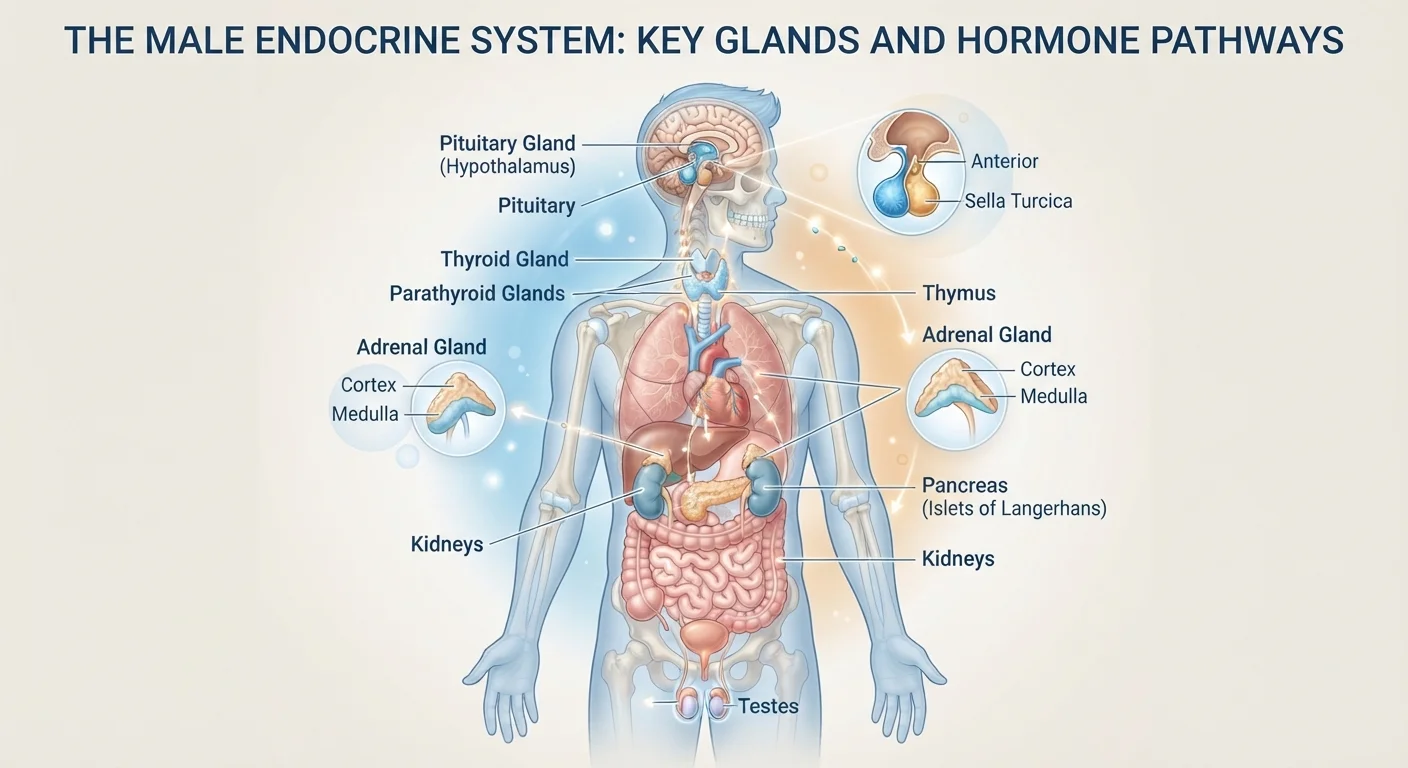
The Bigger Hormonal Picture
When men think about hormones and aging, testosterone usually dominates the conversation. But the endocrine system is far more complex. Several other hormones shift meaningfully as men move through their 50s, 60s, and beyond — and their effects on energy, body composition, mood, and metabolic health are well documented in clinical literature.
This reference covers four key hormones beyond testosterone: cortisol, DHEA (dehydroepiandrosterone), growth hormone, and thyroid hormones. Understanding what each does — and how age-related changes may be noticed — helps men have more informed conversations with their physicians. For a broader overview, see our plain-language guide to hormonal changes after 50.
| Primary stress hormone | Cortisol (adrenal glands) |
| DHEA decline by age 70 | Approximately 80% reduction from youthful peak (Endocrine Society clinical literature) |
| Growth hormone change | GH secretion declines progressively after age 30 |
| Thyroid condition prevalence | Subclinical hypothyroidism increases with age in men |
| Key downstream GH signal | IGF-1 (insulin-like growth factor 1) |
| Evaluation approach | Comprehensive blood panel assessing multiple hormones |
Four Hormones to Know
Cortisol
Cortisol is the body's primary stress hormone, produced by the adrenal glands. It regulates blood sugar, inflammation, immune response, and the sleep-wake cycle. With age, the diurnal pattern of cortisol — its natural rise in the morning and fall at night — can become less pronounced, and evening cortisol levels may remain elevated longer than in younger men. Chronically elevated cortisol is associated with disrupted sleep, increased abdominal fat, and suppressed immune function. Ongoing psychological or physical stress compounds these effects. Chronic stress and poor sleep create a feedback loop that affects multiple hormones simultaneously.
DHEA (Dehydroepiandrosterone)
DHEA is produced by the adrenal glands and serves as a precursor to both testosterone and estrogen. It peaks in early adulthood and declines steadily — by age 70, levels in many men are roughly 20% of their youthful peak. DHEA is associated with energy, immune function, and lean mass maintenance. Research on the effects of declining DHEA in older men is ongoing, and supplementation remains an area of active scientific debate; physicians typically evaluate DHEA in the context of a broader hormonal panel rather than in isolation.
Growth Hormone and IGF-1
Growth hormone (GH), secreted by the pituitary gland, stimulates tissue repair, muscle maintenance, and fat metabolism. It acts largely through a downstream signal called IGF-1 (insulin-like growth factor 1). Both GH and IGF-1 decline with age — a process sometimes called somatopause. This decline contributes to the gradual loss of muscle mass and the gain of body fat that many men notice after middle age. Body composition changes in aging men are closely tied to this GH-IGF-1 axis, alongside testosterone.
Thyroid Hormones
The thyroid gland produces hormones — primarily T4 (thyroxine) and T3 (triiodothyronine) — that govern metabolism, heart rate, body temperature, and cognitive function. Subclinical hypothyroidism (mildly underactive thyroid) becomes more prevalent with age in men, though overt thyroid disease remains less common than in women. Symptoms of low thyroid function — fatigue, weight gain, cold sensitivity, mental sluggishness — can overlap significantly with other age-related hormonal changes, which is why thyroid testing is a standard part of evaluating nonspecific energy complaints in older men.
Cortisol
A steroid hormone produced by the adrenal glands that regulates metabolism, stress response, immune function, and the sleep-wake cycle. Levels naturally follow a daily rhythm that may become disrupted with age.
DHEA
Dehydroepiandrosterone, an adrenal hormone that serves as a building block for testosterone and estrogen. It peaks in early adulthood and declines significantly through the later decades of life.
IGF-1
Insulin-like growth factor 1, a hormone produced mainly by the liver in response to growth hormone. It mediates many of growth hormone's effects on muscle, fat, and tissue repair.
Somatopause
The age-related decline in growth hormone and IGF-1 secretion. It contributes to changes in body composition — including reduced muscle mass and increased body fat — that are common in older men.
Subclinical hypothyroidism
A condition in which thyroid-stimulating hormone (TSH) is mildly elevated but thyroid hormone levels remain in the normal range. It may be associated with subtle symptoms and becomes more common with age.
Diurnal rhythm
The natural 24-hour cycle of a hormone's rise and fall. Cortisol, for example, typically peaks in the early morning and falls to its lowest point at night.
Why These Hormones Matter Together
No hormone operates in isolation. Cortisol elevation can suppress both testosterone and growth hormone secretion. Thyroid dysfunction can alter the metabolism of sex hormones. DHEA decline affects the pool from which androgens are made. This interplay means that fatigue, mood shifts, or body composition changes in an older man may reflect imbalances across several systems — not just one. Energy decline with age often has multiple hormonal contributors.
Symptoms Can Overlap Across Hormones
Fatigue, weight gain, low mood, and poor sleep are associated with changes in cortisol, thyroid hormones, DHEA, and growth hormone — not just testosterone. Because these symptoms are nonspecific, a physician will typically assess several hormonal markers together rather than drawing conclusions from a single test result. Self-diagnosing hormonal imbalances based on symptoms alone is unreliable.
If you notice persistent fatigue, unexplained weight changes, mood disruption, or sleep problems, a comprehensive evaluation by a physician — including relevant blood tests — is the appropriate first step. This article is for informational purposes only and is not a substitute for professional medical advice. Always consult a qualified healthcare provider about symptoms or concerns specific to your health.
This article is for general informational purposes only and does not constitute medical advice. Speak with your healthcare provider about any health concerns.