
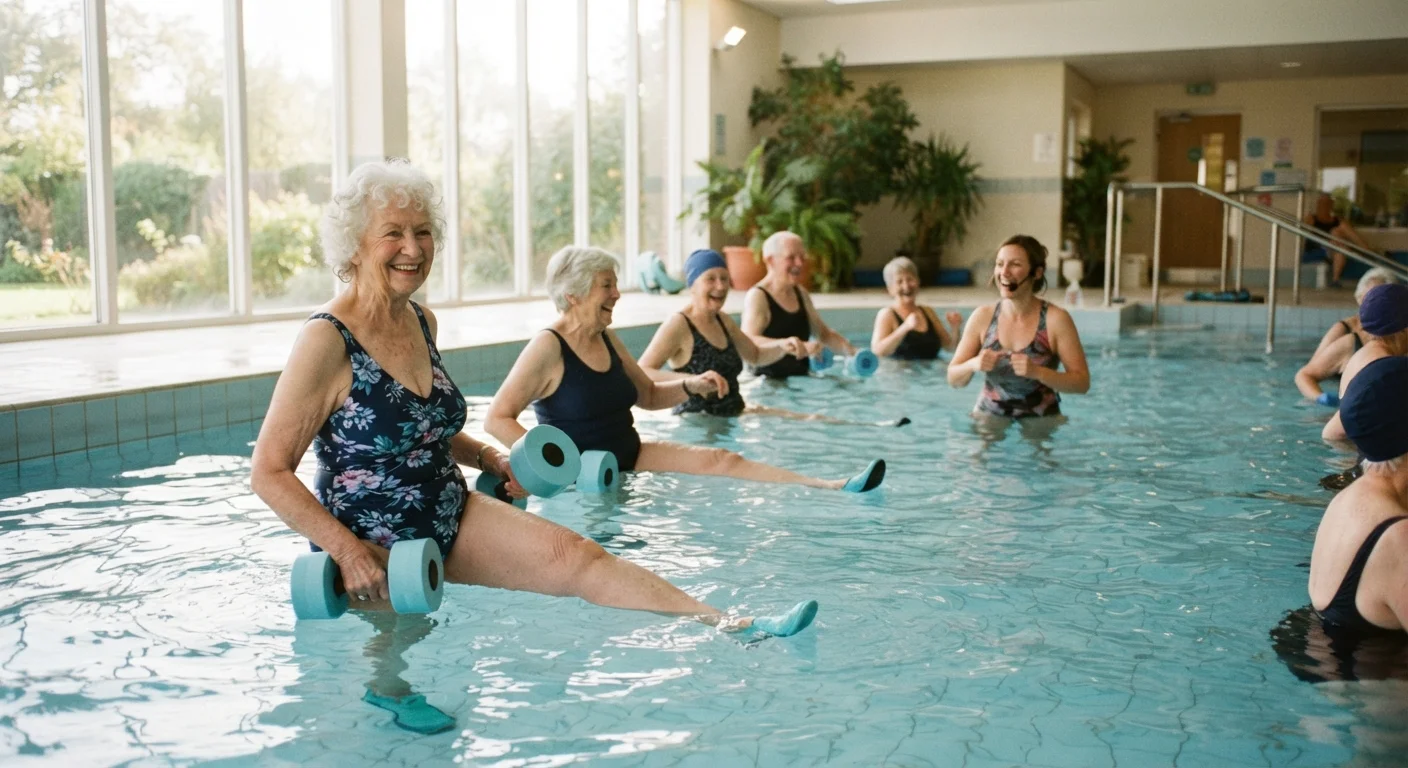
Why the Type of Exercise Matters for Joint Health
Not all movement places the same demands on your joints. For older adults managing stiffness, arthritis, or general joint wear, understanding how an exercise loads the body is just as important as choosing to stay active at all. The two most commonly recommended approaches — aquatic and land-based exercise — protect joints through distinctly different mechanisms, and each has a well-established evidence base.
This comparison is grounded in general health information and is not a substitute for personalized guidance. Anyone with an existing joint condition should discuss exercise choices with a qualified healthcare provider before making changes to their routine. For a broader look at protective movement habits, see our evidence-based principles for joint health.
| Criterion | Aquatic Exercise | Land-Based Exercise |
|---|---|---|
| Joint load | Significantly reduced by buoyancy | Full or partial body weight applied |
| Bone density benefit | Minimal — buoyancy limits bone stimulus | Strong — weight-bearing activates bone remodeling |
| Pain relief during activity | Often high, especially in warm water | Variable; depends on surface and intensity |
| Functional strength gains | Moderate — gravity reduced | High — mimics real-life demands |
| Suitability during flares | Generally well tolerated | May need modification or rest |
| Accessibility | Requires pool access | Widely accessible; minimal equipment needed |
| Balance and fall-prevention training | Limited — water provides extra stability | Effective — trains real-world balance demands |
How Aquatic Exercise Protects Joints
Water creates a uniquely forgiving environment for movement. Buoyancy — the upward force water exerts on a submerged body — dramatically reduces the effective weight pressing down through your hips, knees, and ankles. When standing at chest depth, the joints bear only a fraction of normal body weight, enabling people who struggle to walk comfortably on land to move freely in a pool.
Warm water adds another dimension: heat relaxes surrounding muscles, reduces stiffness, and can improve circulation to joint tissues. These properties make aquatic exercise particularly valuable during arthritis flares or post-surgical rehabilitation. Research published in rheumatology journals consistently shows that hydrotherapy and water aerobics improve pain scores, range of motion, and physical function in people with osteoarthritis and rheumatoid arthritis.
Water also provides gentle resistance in every direction, meaning muscles work throughout the movement — without the jarring impact of hard surfaces. To learn more about the specific role warm water plays, explore our article on why aquatic movement feels different.
~90%
Reduction in joint load at shoulder depth
Buoyancy reduces effective body weight by approximately 90% when submerged to shoulder level, according to widely cited biomechanical principles used in aquatic therapy.
~60%
Reduction in joint load at waist depth
Standing at waist depth reduces body weight through the lower-limb joints by roughly 50–60%, still substantially less than full weight-bearing on land.
2–3×/week
Recommended aquatic exercise frequency
Major rheumatology guidelines generally suggest two to three sessions per week of aquatic or land-based exercise for adults managing osteoarthritis.
What Land-Based Exercise Offers That Water Cannot
Land-based exercise — walking, resistance training, yoga, cycling — covers a wide spectrum of intensities and impacts, but its defining advantage is the mechanical load it places on bones and joints. This load, applied regularly and progressively, stimulates bone-forming cells (osteoblasts) and maintains bone mineral density. Aquatic exercise, despite its many benefits, does not produce this effect because buoyancy removes much of the gravitational stress that triggers bone adaptation.
Functional strength is another key differentiator. Rising from a chair, climbing stairs, and carrying groceries all require muscles to work against gravity — exactly what land-based exercise trains. Programs involving resistance bands, light weights, or bodyweight movements build the muscle support that stabilizes joints during daily tasks, reducing the risk of falls and injury. Our guide to strength training and ageing joints examines how to approach this safely.
For individuals concerned about bone health specifically, weight-bearing exercise and bone strength provides a detailed look at which activities have the strongest evidence.
Land-Based Exercise Doesn't Mean High-Impact
Walking on a flat surface, chair-based resistance exercises, and tai chi all qualify as land-based activities and are considered low-impact. Not every land-based workout involves running or jumping. Older adults with joint concerns can often find land-based options that are comfortable and safe, particularly with guidance from a physiotherapist or exercise specialist familiar with joint conditions.
Choosing an Approach — or Combining Both
The choice between aquatic and land-based exercise rarely needs to be absolute. Many physical therapists and rheumatologists recommend a complementary model: use water-based sessions during periods of higher pain or inflammation, and incorporate low-impact land-based activities — such as walking or gentle resistance training — when comfort allows.
Practical considerations also matter. Pool access, cost, transportation, and comfort in water all influence what is sustainable. An exercise program you can maintain consistently will always outperform a theoretically superior one you avoid. For a broad overview of gentler movement options suited to different comfort levels, see our comparison of low-impact movement options for older adults.
If you are uncertain where to start, a physiotherapist can assess your joint condition and recommend a structured plan. Our article on physiotherapy vs. home exercise programs outlines when supervised guidance adds the most value.
This article provides general health information for educational purposes only and is not a substitute for professional medical advice. Consult a qualified healthcare provider before beginning or modifying any exercise program, particularly if you have a diagnosed joint condition or other health concerns.