
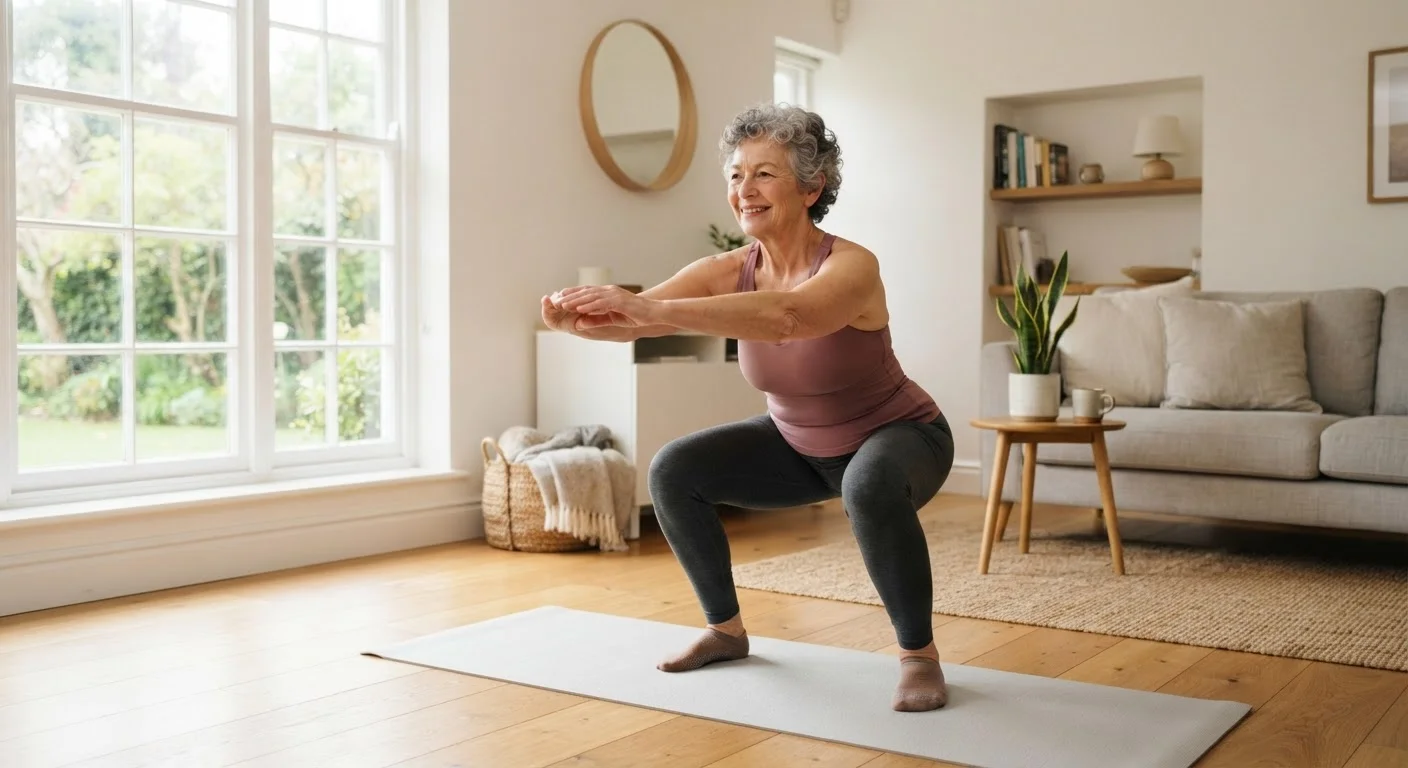
Why Strength Training Matters After 60
Beginning in our 30s, adults gradually lose muscle mass — a process called sarcopenia — at a rate that accelerates after 60. Without intentional resistance exercise, this loss affects balance, bone density, metabolic health, and the ability to perform everyday tasks independently. Strength training is the single most effective countermeasure available.
The evidence is well-established: resistance exercise helps preserve and rebuild muscle tissue, supports bone mineral density, improves insulin sensitivity, and reduces fall risk. It also contributes to functional independence — the ability to carry groceries, rise from a chair, or manage stairs without assistance.
For a broader view of how resistance and cardiovascular exercise each contribute to healthy aging, see Aerobic vs. Resistance Exercise: What Older Adults Actually Need. If you've heard that it's too late to start or that older joints can't handle resistance, Common Beliefs About Exercise in Later Life That Science Doesn't Support addresses those concerns directly with research-grounded context.
Key Concepts Before You Begin
Understanding a few foundational terms helps you follow guidance, communicate with a provider, and make sense of your own progress.
Sarcopenia
The gradual, age-related loss of muscle mass and strength. It begins in midlife and accelerates after 60, but resistance training is the most effective way to slow it down.
Resistance training
Any exercise that causes muscles to work against a force — bodyweight, bands, or weights. Also called strength training or weight training.
Progressive overload
The practice of gradually increasing the challenge placed on muscles over time — through more repetitions, sets, or resistance — so they continue to adapt and strengthen.
Repetition (rep)
One complete movement of an exercise, such as standing up from a chair and sitting back down. A group of consecutive repetitions is called a set.
Rest day
A day between strength sessions when muscles recover and rebuild. Adequate rest is essential for safe progress, especially for older adults whose recovery takes longer.
Functional strength
Muscle strength that directly supports everyday activities like climbing stairs, lifting objects, or rising from a seated position without assistance.
Consult your healthcare provider before beginning any new exercise program, particularly if you have heart disease, osteoporosis, recent joint replacement, or other chronic health conditions. A physical therapist can also help tailor movements to your individual needs and limitations.
Where to Start: Equipment-Free Movements
You do not need a gym membership or weights to begin. Bodyweight exercises provide meaningful resistance for beginners and can be performed safely in most homes. The following movements cover the major muscle groups and have strong practical relevance for daily life.
- Sit-to-stand (chair squats): Rise from a sturdy chair without using your hands, then lower back slowly. This targets the quadriceps and glutes — muscles central to mobility and fall prevention.
- Wall push-ups: Standing arm's length from a wall, press hands flat against it and bend elbows to bring your chest toward the surface, then push back. Builds upper-body and core strength without floor work.
- Heel raises: Standing behind a chair for balance support, rise onto the balls of your feet and lower back down slowly. Strengthens calves and supports ankle stability.
- Seated leg extensions: From a chair, straighten one leg until it is level with your hip, hold briefly, and lower. Engages the quadriceps with minimal joint stress.
- Step-ups: Using the bottom stair and a handrail for support, step up with one foot and follow with the other, then step back down. A functional movement that mirrors real-life demands.
Slow Down Your Repetitions
Performing each movement slowly — around two seconds up and two to three seconds down — increases the time muscles spend under tension, which promotes strength gains more effectively than rushing. It also reduces momentum-driven form errors that can lead to strain. For most beginners, controlled tempo is more important than how much resistance you use.
Aim for 8–12 repetitions of each exercise per session. Two sessions per week, with at least one rest day between them, is a sound starting structure. Prioritize controlled movement over speed — slower, deliberate repetitions are more effective and safer for beginners. For broader context on what common exercise mistakes to avoid, Activity Pitfalls That Can Set Back Older Exercisers is a useful companion read.
How to Progress Safely Over Time
Progressive overload — gradually increasing the challenge placed on muscles — is the mechanism through which strength improves. For older adults, this principle applies just as much as it does for younger exercisers, but the pace of progression should be patient and deliberate.
Common progression strategies include:
- Increasing repetitions within a set (e.g., from 8 to 12) before adding resistance.
- Adding a third set of an exercise once two feel manageable.
- Introducing light resistance bands once bodyweight movements feel easy.
- Transitioning from wall push-ups to incline push-ups using a countertop, then a lower surface over weeks or months.
Distinguish Normal Soreness From Pain
Mild muscle soreness appearing 24–48 hours after a session — sometimes called delayed onset muscle soreness (DOMS) — is a normal sign of adaptation and is not harmful. However, sharp pain during exercise, joint pain, chest discomfort, or dizziness are signals to stop immediately and consult a healthcare provider. Never push through pain that feels acute, localized to a joint, or unusual for you.
Track your sessions simply — even a notebook noting what you did and how it felt — so you can recognize genuine progress and identify when something doesn't feel right. Sharp or joint pain during any movement is a signal to stop and seek guidance; muscle fatigue and mild post-exercise soreness the following day are normal and expected. For a detailed look at how resistance exercise interacts with joint health, Strength Training and Ageing Joints: Weighing the Trade-Offs offers a balanced examination of the benefits and risks.
Pairing Strength Work With Other Activity
Strength training is one pillar of active aging, not the whole structure. Balance work, flexibility, and aerobic activity each contribute something distinct that resistance training alone does not fully provide.
Balance Exercises That Reduce Fall Risk in Older Adults describes evidence-backed stability exercises that pair naturally with a strength routine. For readers building a complete movement habit, Active Aging: The Full Picture of Exercise, Movement, and Mobility After 60 provides a comprehensive framework. And if you prefer company while you exercise, Group Exercise vs. Solo Training for Older Adults explores the trade-offs between group classes and working out independently.
Nutrition also plays a role in supporting muscle health. The Nutrition & Aging hub covers dietary patterns that complement an active lifestyle for older adults.
A Note on Individual Variation
No two older adults start from the same baseline. Factors such as prior activity history, existing health conditions, medications, and body composition all influence how your body responds to resistance training. What works well for one person may need adjustment for another. Using guidance like this as a starting framework — then adapting it with input from a healthcare provider or certified fitness professional — is the most reliable approach.
This article is for general informational purposes only and is not a substitute for personalized medical advice. Speak with a qualified healthcare professional before beginning any new exercise program, particularly if you have existing health conditions or recent injuries.