
Why Balance Declines With Age — and Why It Matters
Balance depends on a continuous conversation between your muscles, joints, eyes, and inner ear. As we age, each of these systems gradually becomes less precise. Muscle mass declines, sensory signals slow, and the brain's ability to integrate that information loses some of its speed. The result is a meaningful increase in fall risk — and falls carry serious consequences, from fractures to loss of confidence in daily movement.
According to the Centers for Disease Control and Prevention (CDC), falls are the leading cause of injury-related death among adults aged 65 and older in the United States, and roughly one in four older adults reports a fall each year. The encouraging reality is that this risk is not fixed. Research consistently shows that targeted balance training can reduce fall rates in older adults — sometimes by 20 to 30 percent — when practiced consistently over time.
For women with low bone density, fall prevention carries added urgency. Our overview of fall prevention as a bone health strategy explains which interventions have the strongest evidence. And if you are also interested in building the lower-body strength that supports balance, see our complete starting point for strength training in later life.
What you will need
Balance Exercises to Practice Regularly
The exercises below are drawn from programs with clinical support, including those recommended by the CDC's STEADI (Stopping Elderly Accidents, Deaths, and Injuries) initiative and widely used in physical therapy settings. Start with exercises that feel manageable, and progress only when you feel confident. A sturdy chair or countertop should always be within arm's reach.
Weight Shifts Side to Side
Stand behind a sturdy chair with both hands lightly resting on the back. Shift your weight slowly onto your right foot, lifting your left foot slightly off the floor. Hold for 5–10 seconds, then shift to the left side. Repeat 10 times on each side.
This exercise trains your body's ability to recover balance when your center of gravity shifts — a key skill for navigating uneven terrain or stepping sideways.
Heel-to-Toe Walk (Tandem Walking)
Stand near a wall or hallway for support. Place one foot directly in front of the other so the heel of your front foot touches the toes of your back foot. Walk forward in this narrow, straight-line pattern for 10–15 steps, then turn carefully and return. Repeat 2–3 times.
Tandem walking challenges your lateral stability and proprioception (your sense of body position in space), both of which tend to weaken with age.
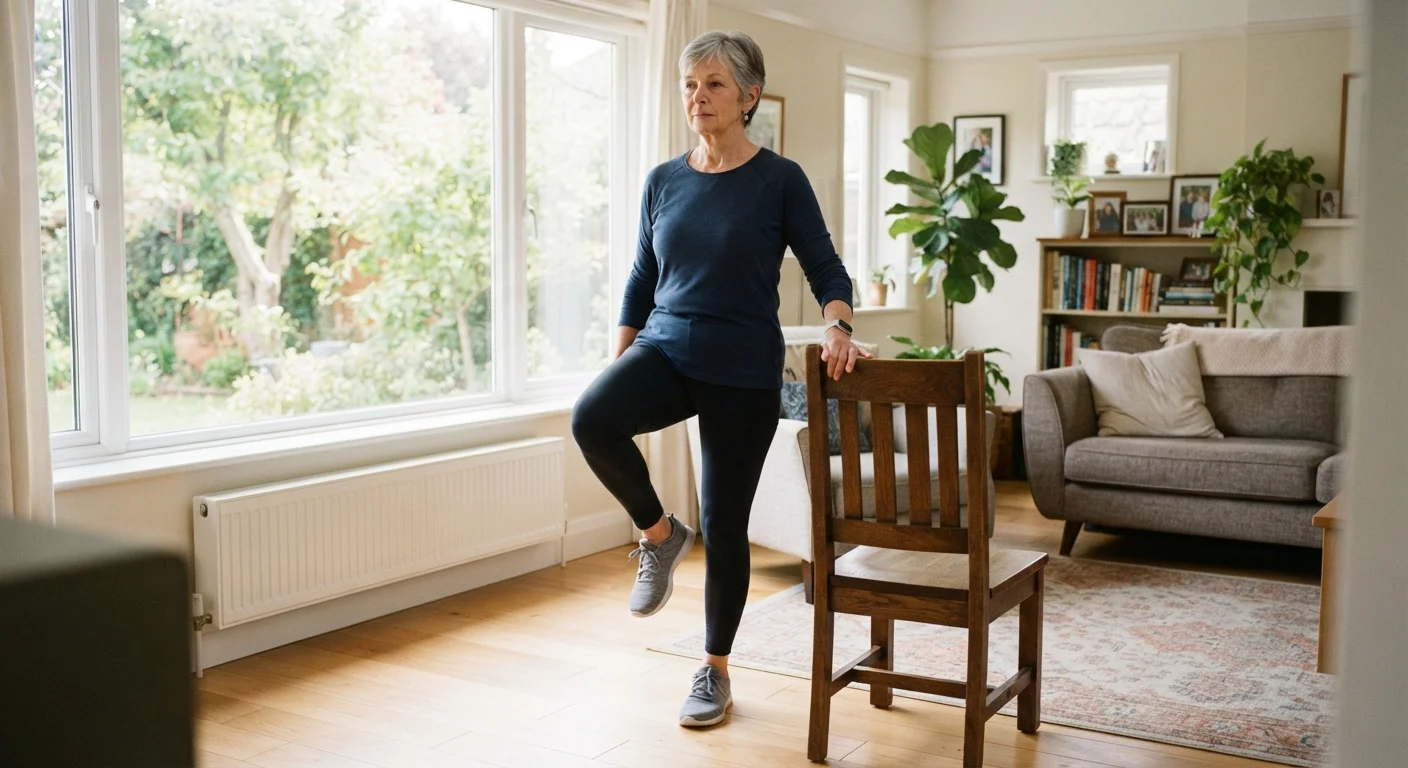
Single-Leg Stand
Hold a chair back lightly and lift one foot a few inches off the floor. Hold for up to 10 seconds, then switch sides. Work toward performing this with fingertip contact only on the chair, and eventually with hands hovering near — but not touching — the support.
This is one of the most well-studied balance exercises in older adult research. Even small improvements in single-leg stance duration correlate with reduced fall risk.
Heel and Toe Raises
Stand behind a chair with hands resting lightly on the back. Rise slowly onto the balls of your feet (toe raise), hold for 2–3 seconds, then lower. Follow with a heel raise: rock back onto your heels, lifting your toes off the floor, hold briefly, and return. Perform 10–15 repetitions of each.
These movements strengthen the ankle musculature — a critical and often overlooked component of balance — and improve the ankle's response time when you stumble.
Sit-to-Stand Practice
Sit in a firm chair with your feet flat on the floor, hip-width apart. Lean slightly forward from the hips (not the waist), then press through your feet to stand up — avoiding pushing off the armrests unless medically necessary. Lower yourself back to seated slowly. Aim for 10 repetitions.
This exercise builds the leg and hip strength needed for safe daily transitions, and is strongly associated with fall prevention outcomes in clinical trials. It also directly supports balance by reinforcing the muscles used when recovering from a stumble. For a deeper look at how resistance training complements balance work, see our article on strength training for older adults.
Consistency Matters More Than Duration
Short, frequent sessions — even 10 to 15 minutes most days — produce better balance outcomes than occasional longer workouts. Aim to incorporate these exercises into your daily routine, such as after breakfast or before your evening walk. Building the habit is the most important step.
For broader context on how daily movement habits — beyond formal exercise sessions — reinforce balance and independence, explore our article on movement habits that support independence in later life. And to avoid common missteps that can derail progress, review our guide on activity pitfalls that can set back older exercisers.
This article is for informational purposes only and does not constitute medical advice. Always consult your physician or a qualified healthcare provider before beginning any new exercise program, particularly if you have a history of falls, balance disorders, cardiovascular conditions, or joint problems.