
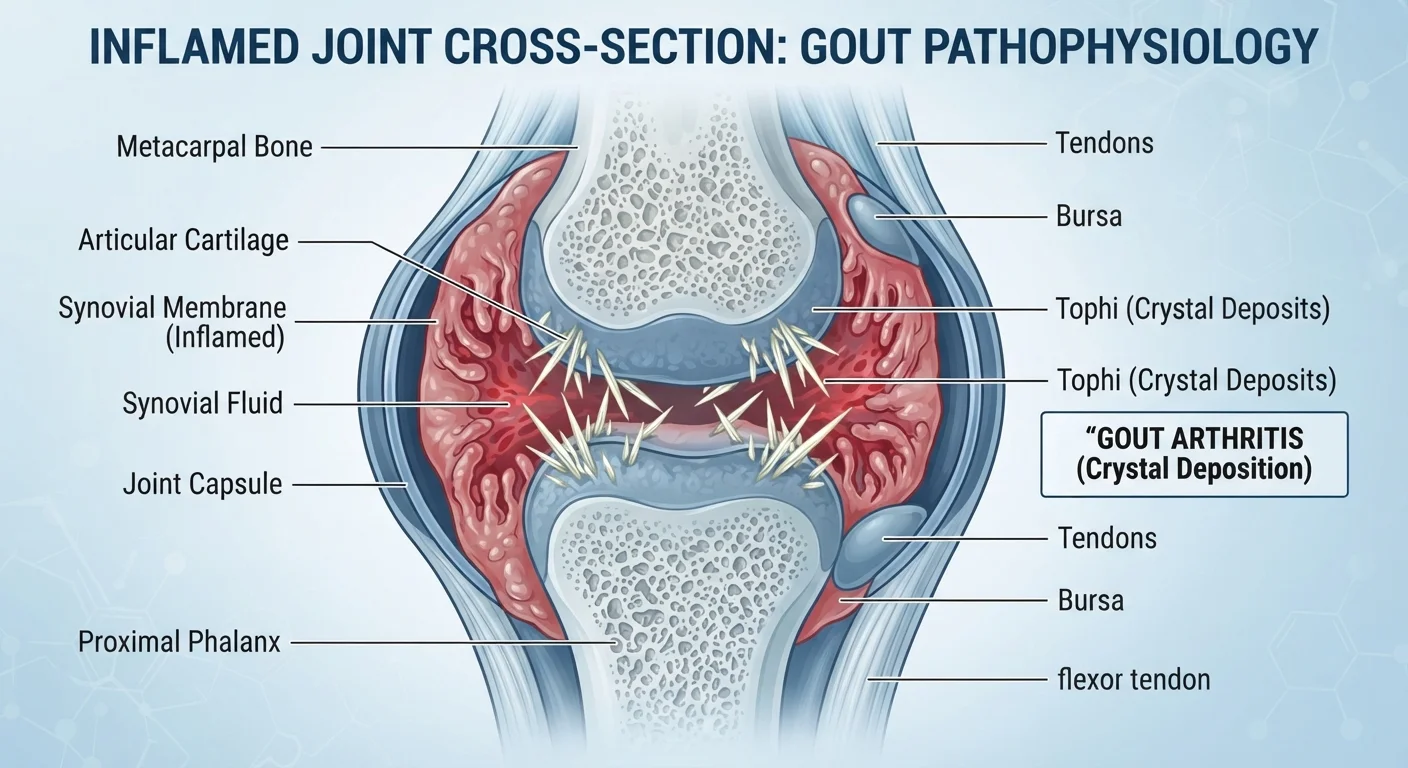
What Makes These Two Conditions 'Crystal Arthritis'?
Both gout and pseudogout belong to a category called crystal-induced arthritis — conditions where microscopic crystals form inside joints and trigger an acute inflammatory response. Despite sharing this mechanism, the two conditions involve entirely different types of crystals, attack different joints, and carry distinct risk profiles.
Gout is caused by the accumulation of monosodium urate (MSU) crystals, which form when blood uric acid levels rise too high — a state called hyperuricemia. Pseudogout, by contrast, results from deposits of calcium pyrophosphate dihydrate (CPP) crystals in joint cartilage and fluid. Its full medical name is calcium pyrophosphate deposition disease, or CPPD.
For a broader look at how these fit among other joint conditions, see our plain-language guide to arthritis types.
| Criterion | Gout | Pseudogout |
|---|---|---|
| Crystal type | Monosodium urate (MSU) | Calcium pyrophosphate (CPP) |
| Most common joint | Big toe (podagra) | Knee |
| Other joints affected | Ankle, heel, wrist, knee | Wrist, ankle, shoulder |
| Peak age of onset | 30s–50s (men); post-menopause (women) | 60 and older |
| Key risk factors | Diet, obesity, kidney disease | Age, joint injury, metabolic disorders |
| Dietary triggers | Yes — purines, alcohol | No established dietary link |
| Visible on X-ray | Tophi in chronic cases | Chondrocalcinosis (calcium in cartilage) |
| Definitive diagnosis | Joint fluid analysis (MSU crystals) | Joint fluid analysis (CPP crystals) |
Symptoms and Affected Joints
Both conditions produce sudden, severe joint pain — often described as one of the most painful experiences a person can have. Redness, warmth, swelling, and tenderness are common to both. However, the joints involved differ significantly.
Gout classically targets the big toe (a presentation called podagra), though it can also affect the ankle, heel, midfoot, and knee. Flares typically peak within 12–24 hours and may resolve within days to weeks without treatment. Repeated untreated flares can lead to chronic joint damage and the formation of tophi — lumps of uric acid crystal deposits under the skin.
Pseudogout most frequently affects the knee, followed by the wrist, ankle, and other large joints. Flares can mimic gout closely enough that the name pseudogout — meaning "false gout" — was chosen specifically because of this resemblance. Both conditions can also be mistaken for septic arthritis (a joint infection), which is why professional diagnosis is critical.
Because both are inflammatory in nature, they share characteristics discussed in our article on inflammatory versus non-inflammatory arthritis.
~8.3M
Adults affected by gout in the US
According to CDC estimates, approximately 8.3 million American adults are affected by gout, making it the most common inflammatory arthritis.
~7–10%
Adults over 80 with CPP deposits
Research published in rheumatology literature estimates that calcium pyrophosphate deposits are detectable in roughly 7–10% of adults over age 80.
3–4x
Higher gout risk in men vs. women
Men are roughly three to four times more likely than premenopausal women to develop gout, according to epidemiological studies.
Risk Factors and Causes
Understanding why crystal arthritis develops can help readers recognise their own risk and have more informed conversations with their doctors.
Gout risk factors include a diet high in purines (found in red meat, organ meats, shellfish, and alcohol — particularly beer), obesity, chronic kidney disease, certain diuretic medications, and a family history of gout. Men develop gout more frequently than premenopausal women, though the gap narrows after menopause. For a deeper look, see our dedicated article on gout and uric acid crystals.
Pseudogout risk factors are somewhat different. Advancing age is the strongest predictor — CPP deposits become increasingly common after age 60. Other contributing factors include prior joint injury, overactive parathyroid gland (hyperparathyroidism), low magnesium levels (hypomagnesemia), excess iron storage (hemochromatosis), and underactive thyroid (hypothyroidism). Unlike gout, pseudogout has no clear dietary trigger.
When Pseudogout Resembles a Joint Infection
A pseudogout flare can closely mimic septic arthritis — a serious bacterial joint infection — with similar redness, warmth, and severe pain. Clinicians routinely test joint fluid to rule out infection before confirming a crystal arthritis diagnosis. Never attempt to self-diagnose a sudden, severely painful joint; seek medical evaluation promptly.
Diagnosis and Management
Because both conditions look similar and can resemble other serious joint problems, professional diagnosis is essential. The gold standard is arthrocentesis — a procedure in which a clinician draws a small amount of fluid from the affected joint and examines it under a polarised light microscope. MSU crystals (gout) appear needle-shaped, while CPP crystals (pseudogout) appear rhomboid-shaped. X-rays may show calcium deposits in cartilage in pseudogout cases, a finding called chondrocalcinosis.
Management of acute flares for both conditions typically involves reducing inflammation. Clinicians may consider nonsteroidal anti-inflammatory medications, colchicine, or corticosteroids depending on individual patient circumstances — your doctor will determine what is appropriate for you. Long-term gout management often includes strategies to lower uric acid levels, including dietary changes and, in some cases, prescribed medications. Pseudogout has no equivalent crystal-removal therapy; management focuses on controlling flares and addressing any underlying metabolic conditions.
This article is general health information only and is not a substitute for advice from a qualified healthcare professional. Always consult your doctor if you experience sudden, severe joint pain. For context on how crystal arthritis differs from other common types, explore osteoarthritis versus rheumatoid arthritis.
This article is for informational purposes only and does not constitute medical advice. Please consult a qualified healthcare professional for any personal health concerns or before making changes to your treatment plan.