
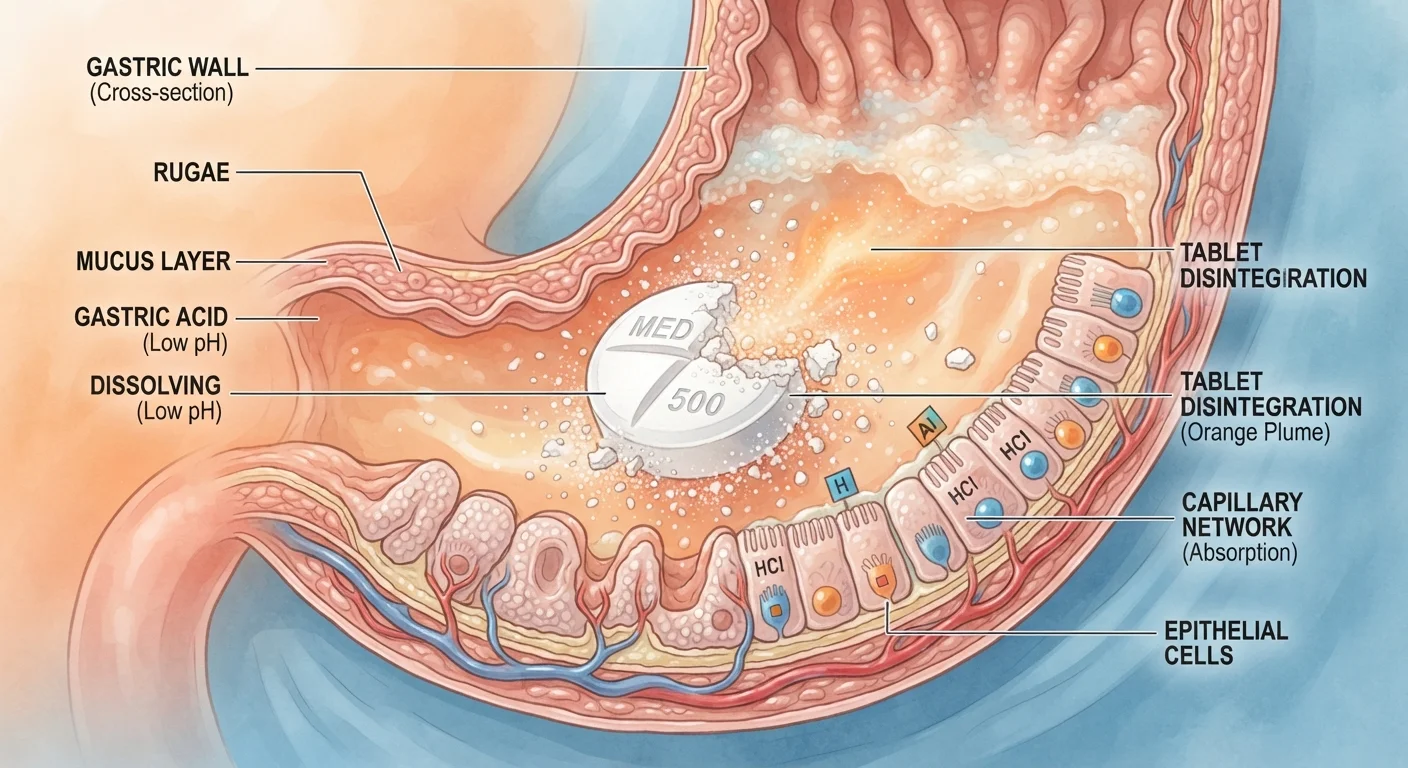
Step One: Dissolving in the Stomach
The moment you swallow a tablet with water, your body begins a precisely staged process. The pill travels down the esophagus and lands in the stomach, where acid and digestive fluid start breaking down its outer coating or shell. For most standard tablets, this dissolution phase takes roughly 15 to 30 minutes.
The coating on many pills isn't cosmetic — it serves a purpose. Some coatings protect the stomach from irritating ingredients. Others, called enteric coatings, are designed to resist stomach acid entirely and only dissolve further along in the digestive tract. Capsules filled with powder or liquid tend to dissolve slightly faster than compressed tablets.
This is why crushing or splitting certain pills can be problematic — it can disrupt the controlled release design. Reading your prescription label carefully will often tell you whether a tablet should be taken whole.
Step Two: Absorption Into the Bloodstream
After dissolving, the active drug molecules move from the stomach into the small intestine, where the bulk of absorption occurs. The intestinal lining is lined with millions of tiny finger-like projections called villi, which dramatically increase the surface area available for absorbing nutrients — and medications.
Drug molecules pass through the intestinal wall and enter small blood vessels. From there, they travel via the portal vein directly to the liver before reaching general circulation. This liver stop is called first-pass metabolism: the liver chemically alters a portion of the drug, reducing how much ultimately enters the bloodstream. For some medications, this is a significant factor in determining the effective dose.
~80%
Of medications taken orally
The oral route accounts for roughly 80% of all medications administered, making it the most common drug delivery method worldwide, according to pharmaceutical research literature.
30–90 min
Typical onset time for standard tablets
Most conventional oral tablets begin releasing active ingredients into the bloodstream within 30 to 90 minutes under normal digestive conditions.
40%+
Dose lost to first-pass metabolism (some drugs)
For certain medications, first-pass liver metabolism can eliminate more than 40% of the original dose before it reaches systemic circulation, according to established pharmacokinetic studies.
Food in your digestive tract at the time of absorption can meaningfully change this process — slowing it, accelerating it, or in some cases blocking it. Common substances like grapefruit juice or calcium supplements are known to interfere with specific drug absorption pathways.
Step Three: Distribution, Action, and Elimination
Once in the bloodstream, drug molecules are transported throughout the body. Whether a drug reaches a specific organ, tissue, or cell depends on its chemical structure and how well it binds to carrier proteins in the blood. Some drugs are highly targeted; others are distributed widely.
At the target site — a receptor on a cell, an enzyme, or a protein — the drug produces its intended effect. An antihypertensive drug, for example, relaxes blood vessel walls. A pain reliever blocks chemical signals in the nervous system.
Ask Your Pharmacist About Half-Life
Every drug has a "half-life" — the time it takes for your body to reduce its concentration by half. This is one reason some medications are taken once daily while others require multiple doses. Asking your pharmacist about a drug's half-life can help you understand why missing a dose has different consequences for different medications.
Finally, the body eliminates the drug, primarily through the liver (which converts it into water-soluble waste) and the kidneys (which filter it into urine). This is why kidney or liver conditions can significantly affect how long a drug stays active in the body. Older adults often experience slower elimination, which is one reason dosing for seniors sometimes differs from standard adult recommendations. Always discuss your full health picture with your prescribing physician.
Understanding this journey also helps explain why the same drug can affect different people very differently — individual factors like body composition, genetics, and other medications all influence each step of this process.
Why Timing and Instructions Are Designed Around This Process
Dosage schedules, food requirements, and timing instructions are not arbitrary. They are engineered around the ADME process to maximize a drug's effectiveness and minimize side effects. Taking a medication at the wrong time, with the wrong foods, or in the wrong form can shift the absorption curve enough to reduce benefit or increase risk.
What "take with food" really means varies considerably from drug to drug — for some, it's about protecting the stomach lining; for others, it's about activating absorption. Your pharmacist is the most accessible expert on these specifics and can explain why your particular medication's instructions are written as they are.
This article is for general informational purposes only and is not a substitute for professional medical advice. Always consult your doctor, pharmacist, or another qualified healthcare provider with questions about your medications.