The Digestive Tract Is Not a Neutral Delivery System
Many people assume swallowing a pill is a straightforward event — the tablet goes in, the drug comes out in the blood. But your digestive tract is an active chemical environment, and everything you eat or drink before taking a medication shapes that environment. To understand why food instructions exist, it helps to know what your gut does to a pill. See our plain-language guide to how a pill travels through your body for a full overview.
When a tablet reaches your stomach, it begins to dissolve in stomach acid. The resulting drug particles then pass into the small intestine, where most absorption into the bloodstream happens. Food in that same space affects the acidity, the movement speed of the intestine, and the availability of the drug molecules — all of which change how much of the drug ultimately enters circulation.
~50%
Patients who misread or ignore food-timing instructions
Research published in pharmacoepidemiology literature consistently finds that roughly half of patients do not follow medication administration instructions as written, including food-timing guidance.
Up to 40%
Reduction in drug absorption when taken incorrectly with food
For some drugs, such as certain bisphosphonates used for osteoporosis, taking the medication with food rather than on an empty stomach can reduce bioavailability by up to 40%, according to established pharmacokinetic studies.
2–3×
Increase in absorption of some fat-soluble drugs with a high-fat meal
Studies on fat-soluble antifungal and certain antiretroviral drugs show that a high-fat meal can increase peak drug concentration in the blood by two to three times compared with fasting conditions.
When Food Helps: Drugs That Work Better With a Meal
Some medications are intentionally designed to be taken with food, for one of two main reasons.
Stomach protection: Certain drugs — particularly nonsteroidal anti-inflammatory drugs (NSAIDs) and some steroids — can irritate or erode the stomach lining when taken on an empty stomach. Food acts as a physical buffer, diluting the drug and coating the stomach wall. Without that buffer, the result is often nausea, stomach pain, or, over time, ulcers.
Improved absorption: Some drugs are fat-soluble, meaning they dissolve and absorb far better in the presence of dietary fat. A notable example is a class of antifungal medications, where a fatty meal can dramatically increase the amount of drug that reaches the bloodstream. Taking these on an empty stomach can render them significantly less effective. For a deeper look at how specific foods interfere with drug action, see our article on how food, drink, and supplements can alter a drug's effect.
When a Snack Is Enough
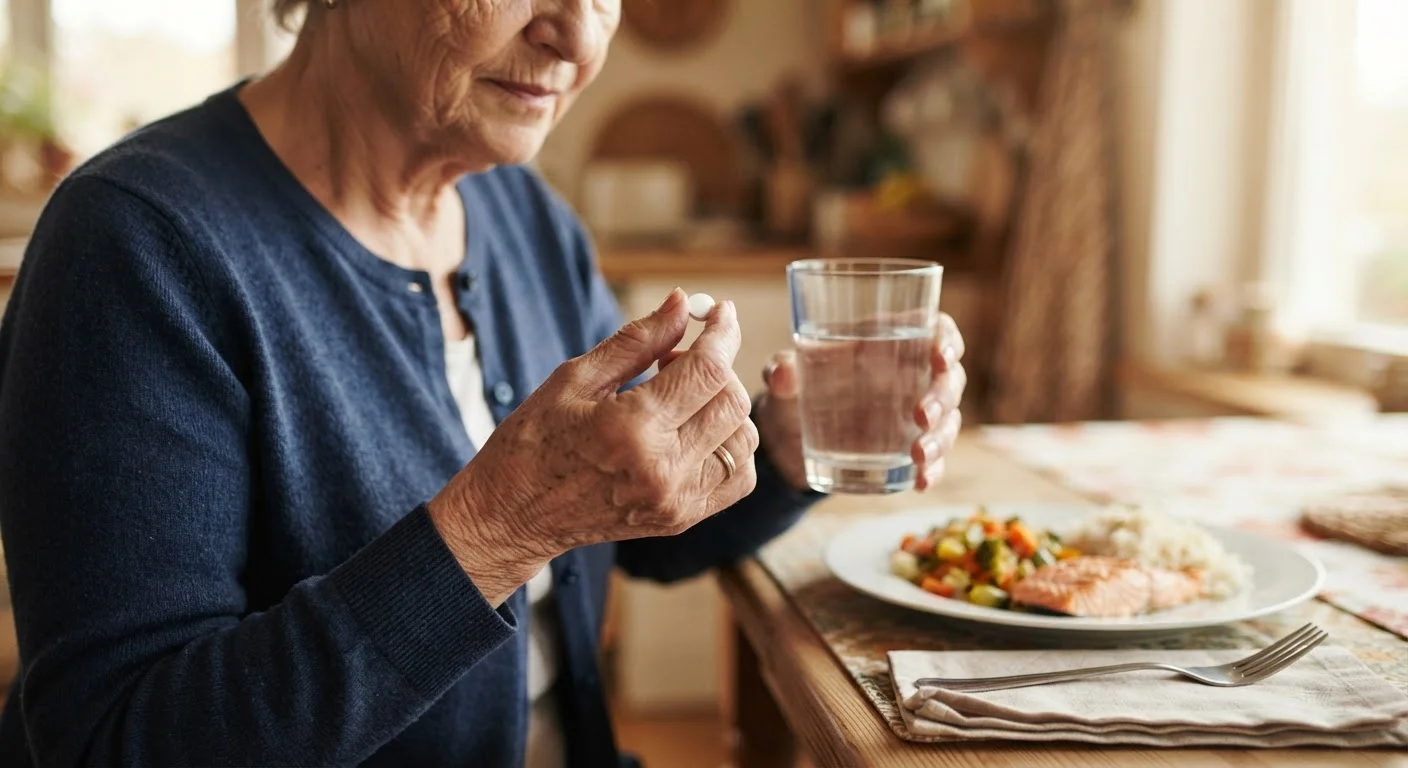
For drugs that ask you to 'take with food,' a small, simple snack — such as a few crackers, a piece of toast, or half a banana — is usually sufficient to protect your stomach and trigger any needed digestive response. You do not always need a full meal. When in doubt, ask your pharmacist how much food is needed for your specific medication.
When Food Hurts: Drugs That Need an Empty Stomach
Other medications work best — or only work properly — when there is no food in the stomach. This happens for several distinct reasons.
Food blocks absorption: Some drugs bind to minerals or proteins found in food, forming complexes that the intestine cannot absorb. Certain thyroid medications and some antibiotics fall into this category. Even calcium-rich foods or dairy can significantly reduce how much of the drug enters your bloodstream if consumed at the same time.
Stomach acid dependency: A handful of drugs require a highly acidic stomach environment to dissolve properly. Food raises stomach pH (makes it less acidic), which can prevent the drug from breaking down in the first place.
Delayed transit: Food slows how quickly the stomach empties into the small intestine. For medications designed to be absorbed rapidly — for example, certain osteoporosis drugs that must reach the intestine quickly and then require the patient to remain upright — that delay disrupts the entire mechanism.
Timing Instructions Vary by Drug Class
Not all medications in the same general category share the same food rules. Two antibiotics, for instance, may have opposite instructions — one requiring food to reduce nausea, another requiring an empty stomach to maximize absorption. Never assume that instructions for one drug in a class apply to another. Always check the label or ask your pharmacist when starting any new medication.
Reading the Label and Asking the Right Questions
Food-timing instructions on prescription bottles are based on clinical pharmacology research, not habit or convention. Ignoring them is one of the most common — and most avoidable — reasons a medication underperforms. Our article on what 'take with food' really means explores the label language in more detail.
If your label says "take with food" and you have no appetite, ask your pharmacist whether a light snack is sufficient — in most cases it is. If it says "on an empty stomach," clarify whether water is acceptable (usually yes) and how long you need to wait after eating.
Older adults often take multiple medications at different times. Getting the food-timing right for each one is a practical part of medication management, and your pharmacist is your best resource. For broader guidance on organizing medications around your daily schedule, see our Managing Your Medications hub.
This article is for general informational and educational purposes only. It is not a substitute for professional medical advice, diagnosis, or treatment. Always consult your prescriber or pharmacist about the correct way to take your specific medications.