
What the Test Actually Measures
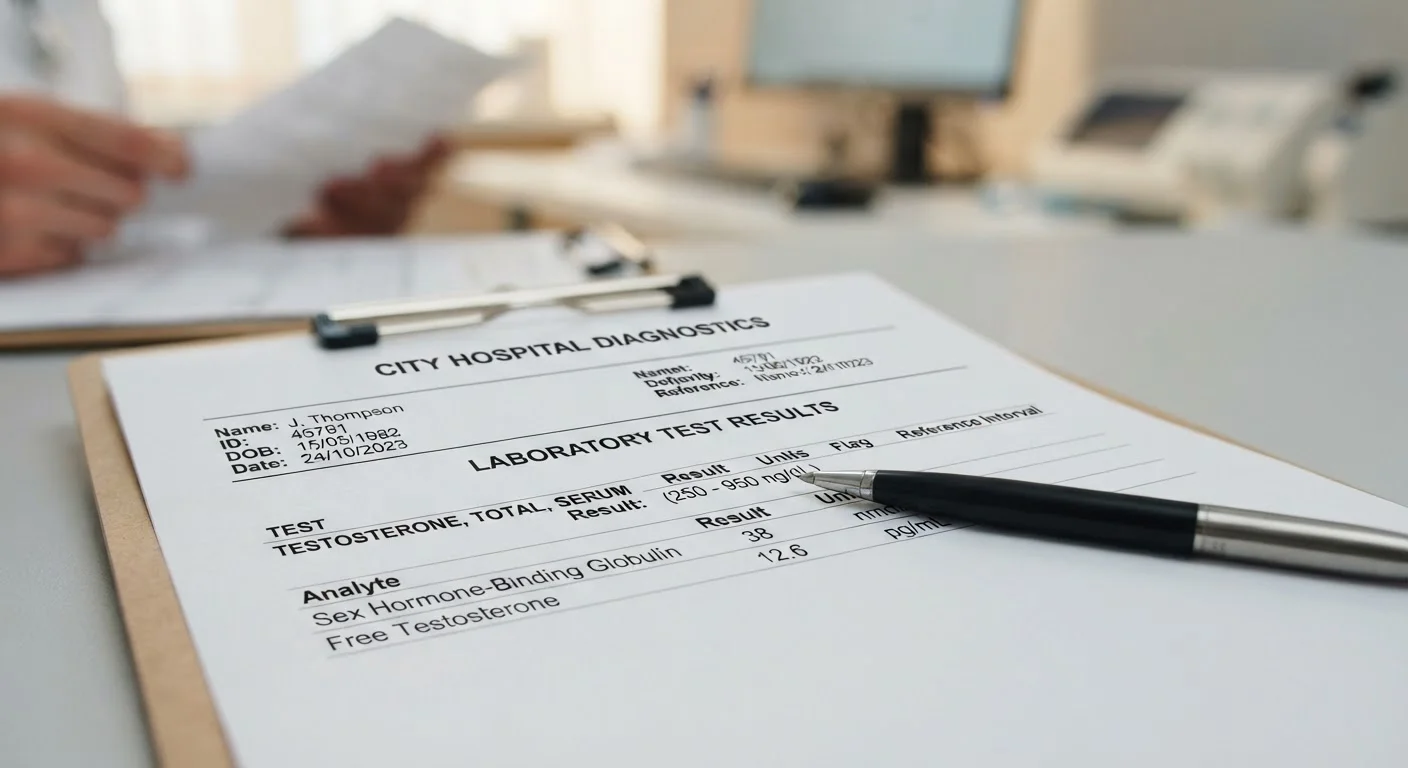
A testosterone blood test sounds straightforward, but the report you receive often contains more than one number — and each tells a slightly different story. Understanding what is being measured helps you have a more productive conversation with your doctor.
| Standard adult male reference range | Approximately 300–1,000 ng/dL (total testosterone) (American Urological Association, 2018 guideline) |
| Free testosterone typical range | Roughly 5–25 ng/dL (varies by lab and method) (Varies by laboratory reference population) |
| Rate of age-related decline | About 1–2% per year after age 30–35 (Endocrine Society clinical literature) |
| Best time to draw the sample | Between 7 a.m. and 10 a.m. (peak circadian levels) (Endocrine Society Clinical Practice Guideline) |
| Minimum confirmatory tests for low T diagnosis | At least two separate morning measurements (American Urological Association, 2018) |
| SHBG impact on aging | SHBG typically rises with age, reducing free testosterone even when total levels appear normal (Journal of Clinical Endocrinology & Metabolism) |
Total testosterone is the broadest measure: it counts all the testosterone traveling through your bloodstream, whether it is tightly bound to proteins, loosely attached, or fully free. Most routine lab panels report total testosterone in nanograms per deciliter (ng/dL).
Free testosterone is a smaller but highly meaningful figure. Because most testosterone is bound to proteins — primarily sex hormone-binding globulin (SHBG) and albumin — only a small fraction is immediately available to tissues. Some clinicians order free testosterone when total levels seem inconsistent with a patient's symptoms.
For a broader view of how testosterone shifts across a man's lifetime, see our overview of testosterone and the aging male body.
Reading the Reference Range — And Why 'Normal' Is Not Simple
Lab reports print a reference range alongside your result — typically around 300–1,000 ng/dL for total testosterone in adult men, though exact cutoffs vary by laboratory. Falling above or below that printed range does not automatically indicate a medical problem or rule one out.
~40%
Men over 45 with low testosterone
A large observational study published in the International Journal of Clinical Practice estimated that roughly 40% of men aged 45 and older seen in primary care settings have low total testosterone levels.
1–2%
Annual testosterone decline after age 30
Research cited by the Endocrine Society indicates testosterone decreases gradually from the early thirties onward, a normal part of male aging rather than a disease in most cases.
~2–3×
Variation in SHBG between individuals
SHBG levels can differ substantially between men of the same age and total testosterone level, which is why free or bioavailable testosterone measurements add important clinical context.
Several factors can shift where your number sits relative to the range:
- Age: Testosterone declines gradually over decades. A result that would be low for a 35-year-old may be consistent with healthy aging for a 70-year-old.
- SHBG levels: As SHBG rises with age, free testosterone can drop even when total levels appear adequate.
- Time of draw: Testosterone peaks in the early morning. A blood draw taken in the afternoon may read lower than one taken at 8 a.m. from the same person.
- Acute illness or stress: Transient illness can suppress levels temporarily, producing a misleadingly low snapshot.
Single Results Are Rarely Enough
Testosterone levels fluctuate throughout the day and can be affected by illness, poor sleep, stress, and recent exercise. Major clinical guidelines recommend confirming any low result with at least one additional morning blood draw before drawing clinical conclusions. Always discuss timing and methodology with your doctor.
Much like interpreting other lab panels — for example, understanding how cholesterol values interact with cardiovascular risk — context matters as much as the number itself.
What 'Borderline' Results Actually Mean
Results clustered just above or below the reference threshold are often described as borderline. This zone generates the most confusion and the most unnecessary anxiety.
A borderline total testosterone result — commonly interpreted as roughly 300–400 ng/dL — does not confirm hypogonadism. Clinical guidelines are clear: a diagnosis requires both a consistently low lab value and symptoms that cannot be explained by other causes. Symptoms such as low energy, reduced libido, mood changes, or difficulty concentrating overlap with many other conditions, including poor sleep, thyroid dysfunction, and depression.
If your result falls in this range, your clinician may order free or bioavailable testosterone, SHBG, luteinizing hormone (LH), and follicle-stimulating hormone (FSH) to build a fuller picture. For a clear explanation of how clinicians distinguish natural age-related change from a condition that warrants evaluation, see low testosterone vs. normal age-related decline.
Just as a single elevated PSA number requires careful interpretation rather than immediate action — as explained in our guide to understanding your PSA test results — a single borderline testosterone result is the beginning of a clinical conversation, not a conclusion.
This article is for general informational purposes only and does not constitute medical advice. Always consult a qualified healthcare professional regarding your individual lab results, symptoms, or treatment options.