
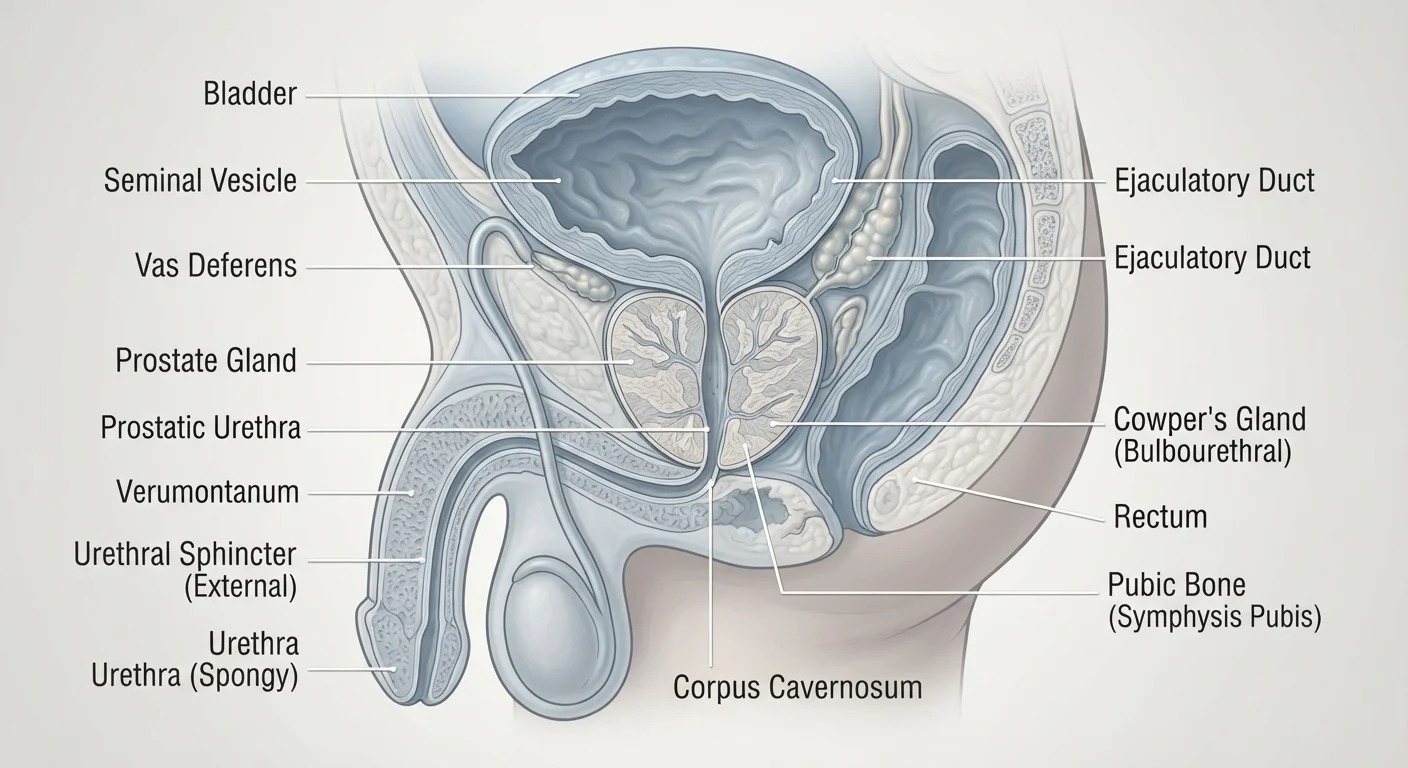
What the Prostate Does
Despite its small size, the prostate gland carries out functions that affect both reproductive and urinary health. Its main role is glandular: it secretes a fluid rich in enzymes and nutrients — including prostate-specific antigen (PSA) — that becomes part of semen. This fluid helps keep sperm viable and mobile after ejaculation.
Equally important is where the prostate sits. It wraps around the urethra just below the bladder, meaning it acts almost like a gateway for urine leaving the body. When the prostate is healthy and a normal size, urine flows freely. When it changes — whether due to inflammation, benign growth, or disease — the urethra can narrow, and urinary symptoms often follow.
For a broader look at prostate anatomy and its role in men's overall health, see this complete prostate health overview.
50%+
Men with BPH by age 60
According to the National Institute of Diabetes and Digestive and Kidney Diseases, more than half of men in their 60s have benign prostatic hyperplasia.
~90%
Men with BPH by their 80s
The prevalence of BPH rises steeply with age, with estimates suggesting roughly 90% of men in their 80s are affected to some degree.
1 in 8
Men diagnosed with prostate cancer in their lifetime
The American Cancer Society estimates that approximately 1 in 8 men will be diagnosed with prostate cancer at some point during his lifetime.
How the Prostate Changes With Age
Prostate growth is one of the most predictable aspects of male aging. During puberty, testosterone drives an initial growth phase. Then, from roughly age 25 onward, the prostate undergoes a second, slower phase of growth that continues throughout life. By age 60, more than half of men have some degree of benign prostatic hyperplasia (BPH) — non-cancerous enlargement of the gland.
Hormones play a central role in this process. Testosterone is converted in the body to a more potent form called dihydrotestosterone (DHT), which stimulates prostate cell growth. As the hormonal environment shifts across a man's lifespan — a topic covered in depth in the testosterone and the aging male body — the prostate responds accordingly.
Importantly, prostate growth alone does not cause symptoms in every man. The degree of urinary disruption depends on which direction the gland grows and how the urethra responds. Some men with significantly enlarged prostates have minimal symptoms; others with modest enlargement experience considerable difficulty.
Track Urinary Changes Over Time
If you notice changes in urinary patterns — frequency, stream strength, or nighttime trips to the bathroom — consider keeping a simple log before your next doctor's visit. Recording when symptoms occur and how often gives your provider more useful information than a general description. These details can help distinguish between BPH, prostatitis, and other conditions.
Three Conditions Worth Knowing
Most prostate health concerns fall into three broad categories, each with distinct causes and implications:
- Benign Prostatic Hyperplasia (BPH): The most common prostate condition, BPH is non-cancerous enlargement that can narrow the urethra and cause urinary symptoms such as a weak stream, frequent nighttime urination, or difficulty starting to urinate. It is not a precursor to prostate cancer.
- Prostatitis: Inflammation of the prostate, which may be caused by bacterial infection or have no identifiable cause. Symptoms can include pelvic pain, painful urination, or flu-like symptoms in acute cases. It affects men of all ages, including younger adults.
- Prostate Cancer: The most serious prostate condition, and one of the most common cancers in men. Many cases grow slowly and may not cause immediate symptoms, which is why screening discussions with a doctor are important — particularly from age 50 onward, or earlier for higher-risk individuals.
Understanding how risk and symptoms shift through each decade of life is explored further in prostate conditions across the lifespan.
Having Informed Conversations With Your Doctor
Urinary changes are often the first clue that something is worth discussing with a healthcare provider. A weak urine stream, waking multiple times per night to urinate, or a persistent feeling that the bladder hasn't emptied are all worth mentioning — even if they seem minor or gradual.
PSA blood tests and digital rectal exams (DREs) are the primary tools for prostate screening. Whether and when to pursue screening involves a nuanced risk-benefit conversation, and guidelines vary across medical organizations. The key is to have that conversation proactively, rather than waiting for symptoms to become disruptive.
Hormonal health is intertwined with prostate health. Men who want a broader picture of how hormonal changes after 50 may be affecting their body can explore the hormonal changes in men after 50 or the hormones beyond testosterone that also shift with age.
This article is for general informational and educational purposes only and is not a substitute for professional medical advice, diagnosis, or treatment. Always consult a qualified healthcare provider with any questions you have about a medical condition or health concern.